

Forensic Engineers and Consultants

Tag Archive: forensic engineering

  1. When a Fire Sprinkler System Fails to Deliver

    Leave a Comment

    After a major fire, it is necessary to investigate the fire sprinkler system to see if and why it malfunctioned. Wet sprinkler systems are the most common and least complex fire sprinkler systems in use. The following are major items addressed in an investigation involving a wet system.

    If available, drawings of the supply piping and sprinkler system are helpful. If these are not available, a sketch of the system will be made. Requests will also be made for inspection, testing, and maintenance documentation as well as fire alarm logs.

    The top reason that fire sprinkler systems do not function correctly during a fire is (more…)
  2. WARREN Welcomes Mechanical Engineer Bob Hickman, P.E.

    Leave a Comment

    Please join us in welcoming Mechanical Engineer Bob Hickman, P.E., to the WARREN family! Bob has over 30 years of manufacturing and machine design experience in production and quality-driven environments. Bob holds a Bachelor of Science in Mechanical Engineering from Clemson University.

    Bob’s Areas of Expertise Include:
    -Machine Safeguarding
    -Machine Design
    -Equipment Failure
    -Mechanical Engineering
    -Industrial Accident Investigation
    -Codes & Standards
    -Machinery & Equipment Damage Assessment
    -Products Liability (more…)

  3. The Concepts of Hazard, Risk, and Harm in Machine Safeguarding

    Leave a Comment

    Hazard, risk, and harm are terms that are used in the world of machine safeguarding.   How do these words shape the concept of machine safeguarding? Let’s look a little deeper….

    Hazard, which Merriam-Webster defines as a noun, lists its first meaning as a source of danger.

    1: a source of danger

    2athe effect of unpredictable and unanalyzable forces in determining events CHANCERISK

      b:  a chance event ACCIDENT  (more…)

  4. Heating System Losses: Part Two

    Leave a Comment

    Previously, Warren posted the first installment of a series on losses associated with heating systems.  The first article looked at central forced air furnaces.  This new article will look at a common form of supplemental or secondary heat, oil filled electric radiant heaters. These heaters are commonly used to provide extra heating in areas that are lacking in central heating capacity. Another rationale for their use arises from manufacturer’s claims that the portable heating units can lower your power bill.  This is based on (more…)

  5. Taking a Practical Approach to Vehicle Fires

    Leave a Comment

    “On average, U.S. fire departments responded to a highway vehicle fire every 182 seconds,” according to the NFPA’s Fire Loss Facts Sheet.

    The National Fire Protection Association (NFPA) says that vehicle fires account for about 20 percent of all reported fires. Before I attempt to examine a vehicle fire loss, I like to check various consumer and government agencies websites to see if I can find any recall or historical data that might be important. This is true for heavy truck fires all the way to automobile and motorcycle fires. (more…)

  6. Lack of HVAC System Design and Poor Installation Lead to Extreme Conditions

    Leave a Comment

    Construction defects can appear in many forms.  The building does not necessarily have to fall down. There are many types of construction defects, including roof leaks, water intrusion into walls, as well as Heating, Ventilation, and Air Conditioning (HVAC) defects.

    One extreme example of this was an office complex I was called to for an investigation of the source of mold observed on the walls.  The occupants complained that they could not find a temperature setting on the thermostat where they could make the office comfortable. When I inspected the office, I couldn’t believe what I was seeing.  A band of black mold (more…)

  7. Industrial Equipment Failures and Construction Disputes

    Leave a Comment

    At Warren, we frequently investigate losses involving industrial machinery.  Many of the losses involve workplace injuries, fires, or explosions; however, we also analyze industrial machinery and processes for other types of problems.  For example, we analyze failures of machinery or industrial processes to perform as expected or disputes that arise from the commercial supply and construction of such systems.  This can encompass a range of issues from failure to achieve required levels of product quality or production quantity, to matters concerning unclear specifications or contracts, (more…)

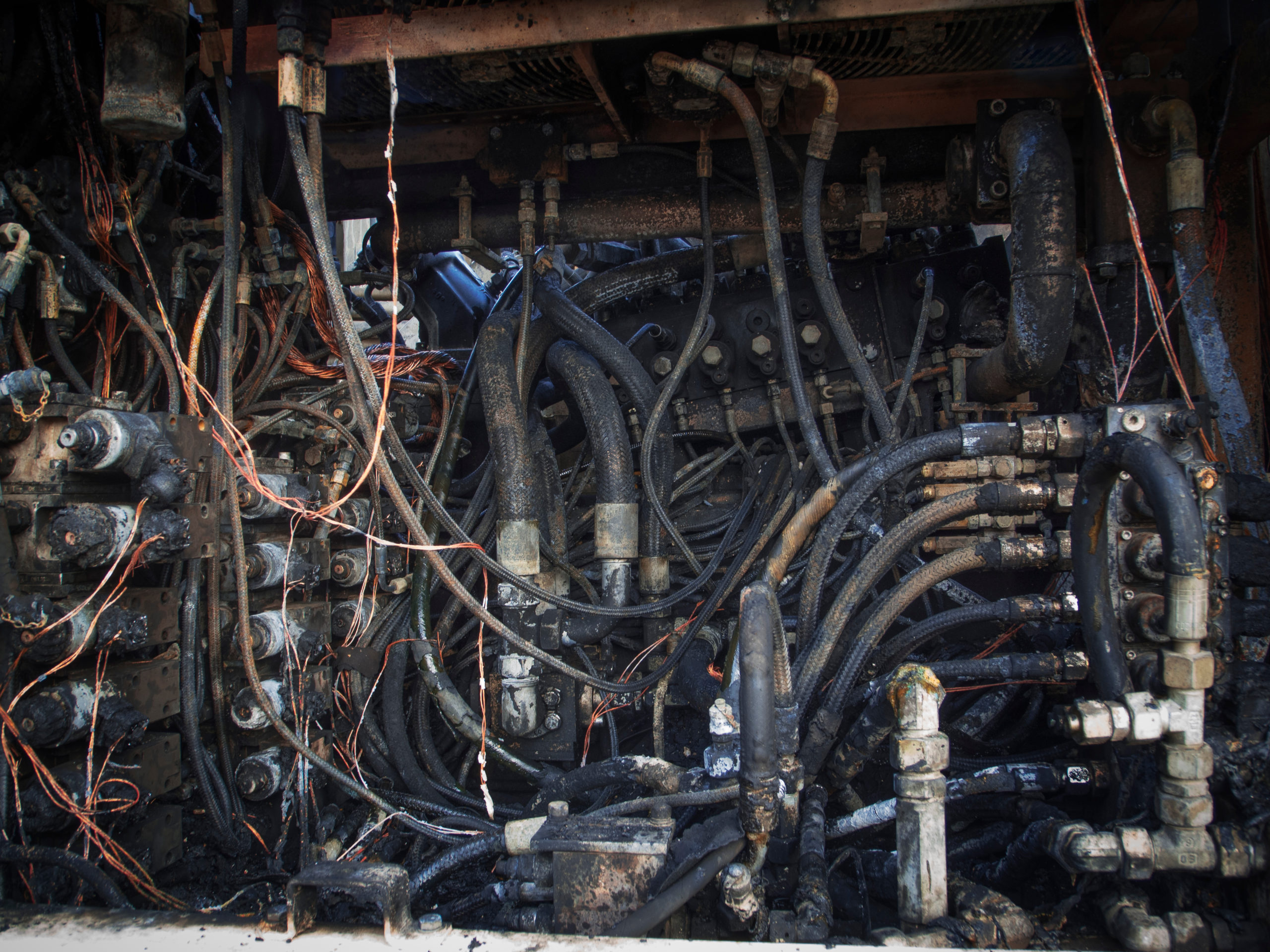
  8. Heavy Machinery Fires Caused by Hydraulic Hose Failures

    Leave a Comment

    Heavy machinery fires are often caused by hydraulic hose failures.  Pressurized hydraulic fluid escaping from a failed hose assembly can be atomized into a fine spray that can be ignited by heated engine surfaces such as the engine exhaust or turbocharger.

    Hydraulic hoses near the engine compartment of an excavator that burned.


    Hydraulic hoses often fail due to age and wear, requiring regular inspection and replacement of hydraulic hoses to prevent failures. Hoses may also fail if they are misrouted.  Misrouting can lead to the hose being pinched or causing it to chafe against a sharp metal surface. (more…)

  9. Interpreting Industrial Incident Data – Lesson Learned

    Leave a Comment

    This is a case study about an incident I investigated involving a major upset in a distillation column.  This blog builds on the previous blogs about the Distributed Control System, DCS – Data is the Key.

    Distillation is a method of separating mixtures of compounds with differing boiling points.  Uncle Bill with his still on the hill separates ethanol, that boils at 173°F, from water that boils at 212°F.  If the mixture is heated to above 173°F, but below 212°F, the ethanol will boil, the vapor will travel up out of the unit and then can be condensed and served over ice with an olive…   Any mixture of two or more chemicals with different boiling points can be separated in this way.  The distillation (more…)

  10. The Condensate System – An Important Item in Routine HVAC Maintenance

    Leave a Comment

    HVAC systems are almost everywhere in the United States now.  As a life-long resident of the humid south that grew up in a home without central air conditioning; I definitely appreciate the ability of a well-designed and maintained HVAC system to remove the oppressive summer humidity.

    The very humidity that makes your clothes damp with sweat and hastened the invention of cooled leather seats in automobiles also has another route to create havoc…condensate.

    In order for an HVAC or “air-conditioning system” to reduce the humidity in the air of your home or office it must first cool the air down to a point where the air can no longer keep the moisture in suspension as water vapor.  The moisture must condense… creating condensate.  This is what is happening when your cool beverage of choice “sweats” on the exterior of the container in the humid summer. Now that you have liquid water, as opposed to water vapor, this condensate must be directed out of your conditioned space to prevent water damage due to backed up or leaking condensate. (more…)

Type ofLoss

Not sure what you're looking for?
Browse All

Select Loss Category