An 8-year-old girl was playing at a playground with her family. The playground was about a year old and very popular. While on the monkey bars about 7 feet up in the air, the child lost her grip and fell to the surrounding loose-fill material engineered wood fiber surface below. She hit her head and sustained serious life-altering injuries.
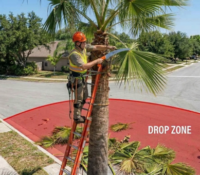
The Red circled area highlights the displaced playground surfacing in the area where the 8-year-old fell. The surfacing material only measured 3 inches deep before hitting hard compacted earth.
I was hired to investigate the incident and determine the cause of the 8-year-old’s injuries. I conducted a site inspection shortly after her fall. The surrounding area under the monkey bars where the child fell was comprised of loose-fill engineered wood fiber. Under the monkey bars was a “scuff mine” or significant depression of displaced surfacing material from frequent use and weather/water drainage. Within the depression, the depth of the engineered wood fiber measured 3 inches. Evidence suggested that when the park was built a year ago, the engineered wood fiber was 12 inches deep. There was not any maintenance program in place to inspect, rake, and replenish lost surfacing material within the playground. Thus, since its original placement, it was unlikely that the surfacing material under the monkey bars had been maintained to a safe critical fall height. Generally, loose-fill material like engineered wood fiber compresses about 25% over time. Thus, a 12 inch deep engineered wood surface would compress to 9 inches and would likely protect children falling from up to 10 feet high. At the time of the inspection, the engineered wood fiber surfacing measured 3 inches and likely only protected children from up to an estimated 3 feet in the air. The 8-year-old fell from the monkey bars located 7 feet in the air onto an insufficient depth of surfacing material. The owners knew or should have known about the dangers of improperly maintained playground surfacing. The owners of the playground failed to maintain the playground according to –STM F1487: Standard Consumer Safety Performance Specification for Playground Equipment for Public Use and CPSC Public Playground Safety Handbook.
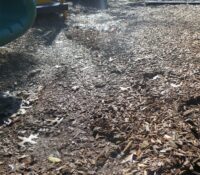
An example of displaced and washed out engineered wood fiber.
All playground surfacing material has a Critical Fall Height (CFH) that determines how much impact it can safely absorb. The Critical Fall Height is the safety threshold for playground surfacing and must always be equal to or greater than the surrounding playground equipment’s actual fall height to be considered safe. For example, if the monkey bars have a fall height of 84 inches (7 feet), the surrounding surfacing material must have a critical fall height of at least 7 feet or taller, meaning that a fall from the monkey bars onto the surrounding surface would likely not result in a serious injury. Had the incident playground been maintained to a critical fall height of at least the fall height of monkey bars (7 feet), the child would not have sustained significant injuries. The owners of the playground should have had a regular maintenance program in place to adequality maintain the critical fall height of the playground surfacing material.
Ellen Szubski, Ph.D., CXLT, CPSI, AHFP, is the senior human factors consultant at The Warren Group. She earned a Doctorate of Philosophy in Human Factors Psychology and a Master of Science in Applied Psychology from Clemson University. She did her dissertation on “The Influence of Pedestrian Biological Motion on Time-To-Collision Estimates at Night”. She is also a Certified XL Tribometrist, Certified Playground Safety Inspector and a Certified Associate Human Factors Professional (AHFP). Prior to entering the forensic field, Ellen planned and conducted experiments for a major bicycle manufacturer. She also conducted laser strike perception studies for the Department of Defense. Ellen applies her experience in Human Factors to the analysis of crash investigations and other personal injury matters. These matters often include collisions involving vulnerable road users and drivers, driver distraction, and slips, trips, and falls. She utilizes her knowledge of OSHA regulations, codes, and standards in her analysis of premises liability incidents and safety consulting. Ellen is a current member of the Human Factors and Ergonomics Society (HFES) and it’s Forensic Professional Technical Group.
Please join us in welcoming Structural Engineer Claire Benedict, P.E., to the WARREN family! Claire has over 10 years of engineering experience in the civil/structural field specializing in building design, building components, and foundation systems analysis. Claire earned her Bachelor of Science in Civil Engineering from Purdue University. Read More
According to the CDC, nearly 70% of all playground injuries are caused by falls to the ground. This makes the choice and maintenance of surfacing materials one of the most important factors in preventing playground injuries. All playground surfacing material has a Critical Fall Height (CFH) that determines how much impact it can safely absorb. The Critical Fall Height is the safety threshold for playground surfacing and must always be equal to or greater than the surrounding playground equipment’s actual fall height to be considered safe. For example, Read More
This article is based on my experience investigating and analyzing slip-and-fall incidents involving pedestrian walking surfaces. One type of slip and fall incident involves slipping on wet floor surfaces shortly after entering a building or stepping onto hard-surface flooring.
Common flooring materials involved include polished concrete, vinyl composite tile, porcelain tile, and wood flooring. These surfaces are generally safe when dry but present increased slip risk when contaminated. Matting is often used as a method to minimize the slip risk but is frequently ineffective because of improper usage. Read More
Grilling outdoor during warmer months is a great way to bring people together, so long as users remember they are literally playing with fire.
Spring weather is wonderful in the south. It’s been a year since I moved and got rid of most of the things we never used in the garage. Now I’m perseverating over which grill to buy so my fiancé and I can finally make grilled turkey legs and stir-fry vegetables while watching the neighbor kids play tag between houses. Despite my pale bald head that sunburns almost instantly, I feel the need for some fresh evening air. Very little makes the afternoon better than sitting in a metal chair and joking about the neighbor’s gazebo plans while you casually take food off the grill.
I have to be honest – I sort of fear the back yard. There are gnats, neighbors with all manner of projectiles (frisbees, basketballs, volleyballs and even footballs have flown past me when all the neighborhood kids are running around!), and all the dust that my edger kicks up. But the social energy of such an active development is why I moved there. It seems a waste to eat dinner on nights like these. After all, a backyard barbecue is the highlight of summer.
But managing fire is one of the most dangerous things you can do in flip-flops. Read More
Slip and falls occur when there is an unexpected loss of traction between a person’s foot and the walking surface, causing them to lose balance and fall. This type of injury is common and can occur in any setting where people walk, including homes, workplaces, and public areas. Slips can result in serious injuries, particularly for older adults.
The human gait cycle consists of four phases: the Read More

“What’s up man, you want to hit up the Longbranch tonight?Cool, I’ll get up with you later.” Ronnie ends the call and heads out on a beer run. After the last sip of Gin, Stan finishes up one of his many fan letters, drops it in the box, and starts to get ready for the night. “What’s good?” It was Ronnie’s cousin Squirrel on the line. “You okay with Stan going tonight?” “Yeah,” Squirrel says, “he’s got a sweet ride… we’ll let him drive! He let me drive that GT all last week, that thing is hot!” “Sounds like a plan! Let me go dude, bout to head in and get some cold beer.”
“911, what’s the nature of your emergency?“
“Yes, there is an overturned car, looks like maybe a Mustang, a red Mustang. I’m just off Highway 9. It’s down an embankment…I can see two people laying on the ground and one person still in the car. The two people on the ground are moving, but the one in the car looks bad!”
“Police and EMS are on the way ma’am.“
“Okay, I have my emergency flashers on, can you stay on the phone with me until they get here… it’s really dark and cold. I’m scared.”
“I’m here ma’am, try to calm down. Can you give me a description of the people involved, maybe what they’re wearing?“
“The one that’s lying near the car is wearing red jeans with a white T-shirt, and it looks like he has a black and green high-top sneaker on his left foot only, just a sock on the other. The other one out of the car has regular blue jeans on, and a green shirt with boots. It’s hard for me to see the guy in the car… looks like he has on jeans and some kind of black concert T-shit, I can see tour dates and make out the word “Shady”. Hey, the police are here, so I’ll hang up now.”
A lot is at stake here and we have quite a dilemma, three occupants involved in a single vehicle crash with one fatality and no idea who the driver is. The stakes begin to rise immediately, at the scene of the crash. What’s documented or not documented will affect the outcome of this case. It will affect the outcome of this case when everyone has gathered with suit and tie, when hands are placed on the Bible, and the truth is sworn to be told.
We’ve talked about proper collision scene documentation several times, but this time let’s talk about a few ways we can build a case like this and possibly identify beyond a reasonable doubt who was driving at the time of the wreck. Read More
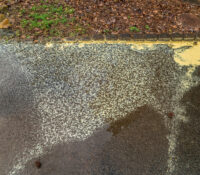
As an experienced safety consultant, I am often called upon to investigate a wide range of premises liability incidents. One common type of incident that frequently results in serious injury is a fall on a painted walking surface.
The ASTM International Standard Practice for Safe Walking Surfaces, ASTM F1637, is a nationally recognized consensus standard that has existed for more than 30 years. It provides guidance to property owners and designers in the construction and maintenance of safe walking surfaces. The standard specifically addresses painted walking surfaces in Section 5.1.3.
ASTM F1637-21 states:
5.1.3 Walkway surfaces shall be slip resistant under expected environmental conditions and use. Painted walkways shall contain an abrasive additive, cross-cut grooving, texturing, or other appropriate means to render the surface slip resistant where wet conditions may be foreseeable.
In conversations with both friends and people I have met through emergency calls with the fire department, I often observed that a lot of people never give a second thought to that little lifesaver mounted on the ceiling or the wall of their home. That little lifesaver is the smoke detector.
On average, a fire department responded to a fire somewhere in the United States every 23 seconds in 2024. A civilian was fatally injured in a fire every two hours and 14 minutes Read More
Stairs that contain three or fewer risers are considered short flight stairs according to safety standard ASTM F1637-21: Standard Practice for Safe Walking Surfaces. Single step transitions are also considered a short flight stair. Short fight stairs can be particularly hazardous for pedestrians due to the lack of visual cues signifying an elevation change. Unexpected changes in elevations can cause pedestrians to misstep and fall. Read More