

Forensic Engineers and Consultants

Tag Archive: forensic testing

  1. Lack of HVAC System Design and Poor Installation Lead to Extreme Conditions

    Leave a Comment

    Construction defects can appear in many forms.  The building does not necessarily have to fall down. There are many types of construction defects, including roof leaks, water intrusion into walls, as well as Heating, Ventilation, and Air Conditioning (HVAC) defects.

    One extreme example of this was an office complex I was called to for an investigation of the source of mold observed on the walls.  The occupants complained that they could not find a temperature setting on the thermostat where they could make the office comfortable. When I inspected the office, I couldn’t believe what I was seeing.  A band of black mold (more…)
  2. Industrial Equipment Failures and Construction Disputes

    Leave a Comment

    At Warren, we frequently investigate losses involving industrial machinery.  Many of the losses involve workplace injuries, fires, or explosions; however, we also analyze industrial machinery and processes for other types of problems.  For example, we analyze failures of machinery or industrial processes to perform as expected or disputes that arise from the commercial supply and construction of such systems.  This can encompass a range of issues from failure to achieve required levels of product quality or production quantity, to matters concerning unclear specifications or contracts, (more…)

  3. Heavy Machinery Fires Caused by Hydraulic Hose Failures

    Leave a Comment

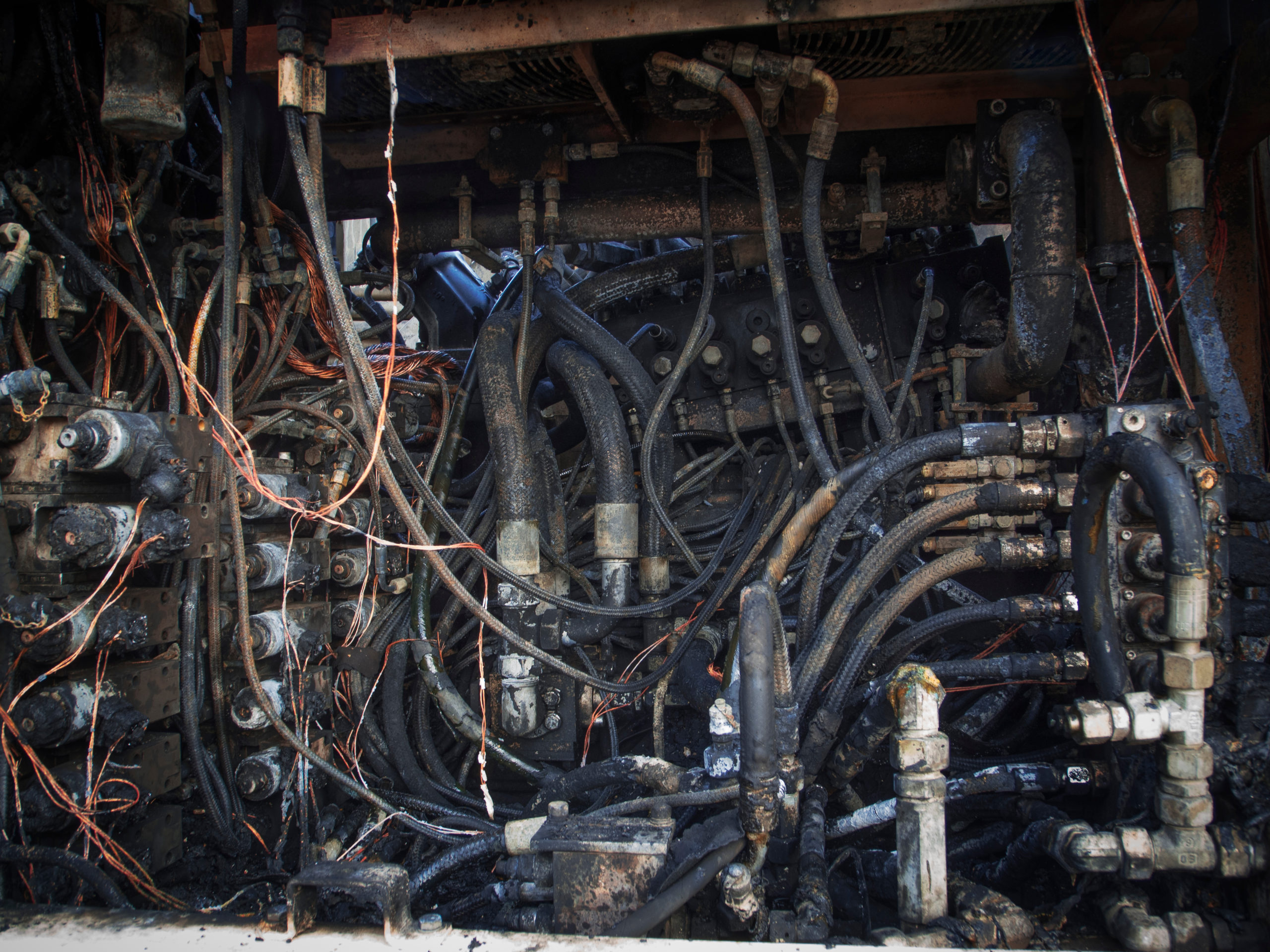
    Heavy machinery fires are often caused by hydraulic hose failures.  Pressurized hydraulic fluid escaping from a failed hose assembly can be atomized into a fine spray that can be ignited by heated engine surfaces such as the engine exhaust or turbocharger.

    Hydraulic hoses near the engine compartment of an excavator that burned.


    Hydraulic hoses often fail due to age and wear, requiring regular inspection and replacement of hydraulic hoses to prevent failures. Hoses may also fail if they are misrouted.  Misrouting can lead to the hose being pinched or causing it to chafe against a sharp metal surface. (more…)

  4. The Condensate System – An Important Item in Routine HVAC Maintenance

    Leave a Comment

    HVAC systems are almost everywhere in the United States now.  As a life-long resident of the humid south that grew up in a home without central air conditioning; I definitely appreciate the ability of a well-designed and maintained HVAC system to remove the oppressive summer humidity.

    The very humidity that makes your clothes damp with sweat and hastened the invention of cooled leather seats in automobiles also has another route to create havoc…condensate.

    In order for an HVAC or “air-conditioning system” to reduce the humidity in the air of your home or office it must first cool the air down to a point where the air can no longer keep the moisture in suspension as water vapor.  The moisture must condense… creating condensate.  This is what is happening when your cool beverage of choice “sweats” on the exterior of the container in the humid summer. Now that you have liquid water, as opposed to water vapor, this condensate must be directed out of your conditioned space to prevent water damage due to backed up or leaking condensate. (more…)

  5. What Does a Recovery Boiler Recover? – Quite a bit, actually!

    Leave a Comment

    The Kraft paper process was invented in 1879 and produces a stronger finished product that other paper manufacturing methods. One of the waste streams is known as black liquor and is a mixture of solids and water.  It contains lignin, hemicelluloses and chemicals used in the pulping process. The original process had no use for this harmful waste stream and it was dumped into nearby waterways, to their detriment!!!  Mr. G.H. Tomlinson invented the recovery boiler in the early 1930’s.  This development made the Kraft process the manufacturing method of choice, as explained below. (more…)

  6. Heat Exchanger Failures Will Shut Your Process Down

    Leave a Comment

    Heat exchangers, as the name implies, are used to bring a process stream to a desired temperature.  They can heat or cool either gases or liquids. They are fairly intricate in their construction, therefore not the cheapest piece of equipment to purchase.  For that reason, facilities don’t keep “spare” exchangers lying around, so when they fail catastrophically, the entire manufacturing process goes down with them… and stays down until they are fixed or replaced. Ow!

    (more…)

  7. Proper Construction and Maintenance Can Prevent Deadly Chimney Fires

    Leave a Comment

    Burning Fireplace

    There are few things as comforting to me during the winter months as a warm fire burning in the fireplace.  And in this case, I am talking the real deal, the kind that warms you multiple times; from cutting, splitting and stacking the firewood until finally lighting a fire in the fireplace.  However, just like your parents taught you, fire can be dangerous.  And having an actual fire in your home fireplace comes with some required maintenance to ensure you can safely control the fire and keep it where it belongs. (more…)

  8. Major Causes of Wood Truss Failures

    Leave a Comment

    Wood truss failures can vary and identifying the cause requires visual inspection as well as a working knowledge of the structural loads and building codes. These truss systems must transfer the gravity and lateral loads to the foundations. Consequently, the framing system and the foundation provide strength and stability for a structure. The most common type of wood-framed construction uses roof trusses, exterior and interior load-bearing walls, beams, girders, posts, and floor framing to resist the gravity and vertical loads. This type of wood-framed construction engages a system of horizontal diaphragms (roof and floors) and shear walls (vertical exterior sheathed walls) to resist the lateral loads. (more…)

  9. Stress Corrosion Cracking of Stainless Steel in Marine Environments

    Leave a Comment

    Stress corrosion cracking involves the slow growth of small, often microscopic, cracks through a metal part in a corrosive environment.  The cracking can continue to the point that the part fails suddenly and unexpectedly even though it still appears new and in good condition.

    My first experience with stress corrosion cracking happened in the Charleston harbor when the stainless steel rudder suddenly separated from a sailboat during moderate winds. What had been a pleasant evening sail turned instantly into being in a difficult to control boat in the middle of the busy shipping channel. The rudder remained attached only (more…)

  10. Heating System Losses, Part One

    Leave a Comment

    When fall and winter arrive and temperatures drop, it is a great comfort to have a heating system to warm your home or office. Several categories of heating equipment exist to provide both primary and secondary heating. Primary heating systems include fuel gas/fuel oil/electric forced air furnaces, heat pumps, hydronic heating/steam systems and even wood-fired heating systems.  Secondary heating equipment includes electric, gas and kerosene space heaters of both fixed and portable design, and fireplaces. Each of the different types of heating systems have unique hazards that, uncontrolled, can result in fires, explosions, burn injuries, and carbon monoxide poisoning.  (more…)

Type ofLoss

Not sure what you're looking for?
Browse All

Select Loss Category