

Author Mark Turner
Maybe you, a loved one, or even a client, have been in the unfortunate position, no pun intended, of being the creamy center in a three-car wreck. Odds are high that you have not, but those odds are also equally high that if you have, you will be shown as one of the contributors to the collision. In other words, the wreck will likely be your fault-and possibly the fault of the person behind you as well. Sure, the wreck could be the fault of the middle and third cars… that wreck would look something like this; as traffic starts to slow, the lead car slows as well, keeping a safe distance between it and the car in front, when suddenly its struck from behind by the middle car. Then typically, the third car follows too closely and strikes the middle car in the rear. Granted, these types of chain reaction wrecks happen extremely fast and can be difficult to discern by both witnesses and even the vehicle occupants. But what if the wreck did not happen that way at all? Let’s look at this same wreck with a different set of glasses… suppose the lead car is slowing down for the vehicle in front, the middle car is slowing down for the lead car and then bang, the middle car is struck from behind by the third car and pushed into the lead car. Clear as mud? This is actually quite common, and leaves you, a loved one, or maybe your client with a traffic ticket, higher insurance, and possibly, to make matters worse, pending litigation. But take heart friends, this wreck is not the fault of the middle car, and we can prove it!
Event Data Recordings stored in a vehicle’s Airbag Control Module will typically record a longitudinal Delta-V or change of velocity. When the force acting on the vehicle is front to rear, the Delta-V is recorded as a negative value. Conversely, when the force acting on the vehicle is rear to front, the Delta-V is recorded as a positive value. I will not get into the weeds of all the ways this can manifest itself in terms of EDR Deployment and Non-Deployment Events, but suffice it to say, there will be sequencing to the recorded change of velocities, and that’s the clues we are looking for. In simplest terms, if a positive Delta-V proceeds a negative Delta-V, in the recorded EDR Data, then the middle car was struck first, and pushed into the lead car. This can also be reflected in the EDR recorded vehicle speeds and in conjunction with EDR data from the other vehicles involved. Let’s look at a couple examples of this from the middle car perspective:

This example is a middle vehicle involved in a three-car collision on the interstate and was shown to be contributing to the collision by the investigating officer. The vehicle’s EDR recorded one Non-Deployment Event with a positive 6.00 mile per hour Delta-V. The initial impact to the left rear caused a clockwise rotation, resulting in the left front striking the lead vehicle. Had the middle vehicle struck the lead vehicle first, the EDR would have recorded a negative value for the Longitudinal Delta-V, assuming the algorithm threshold was met.
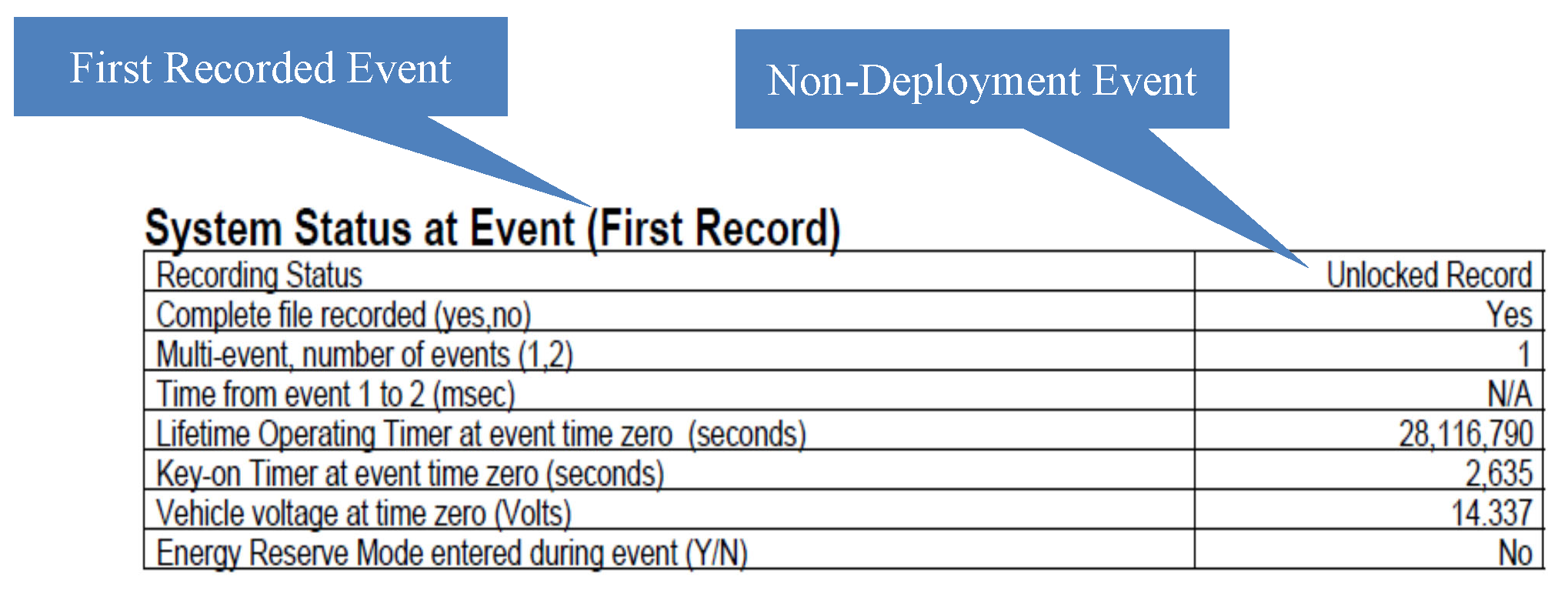
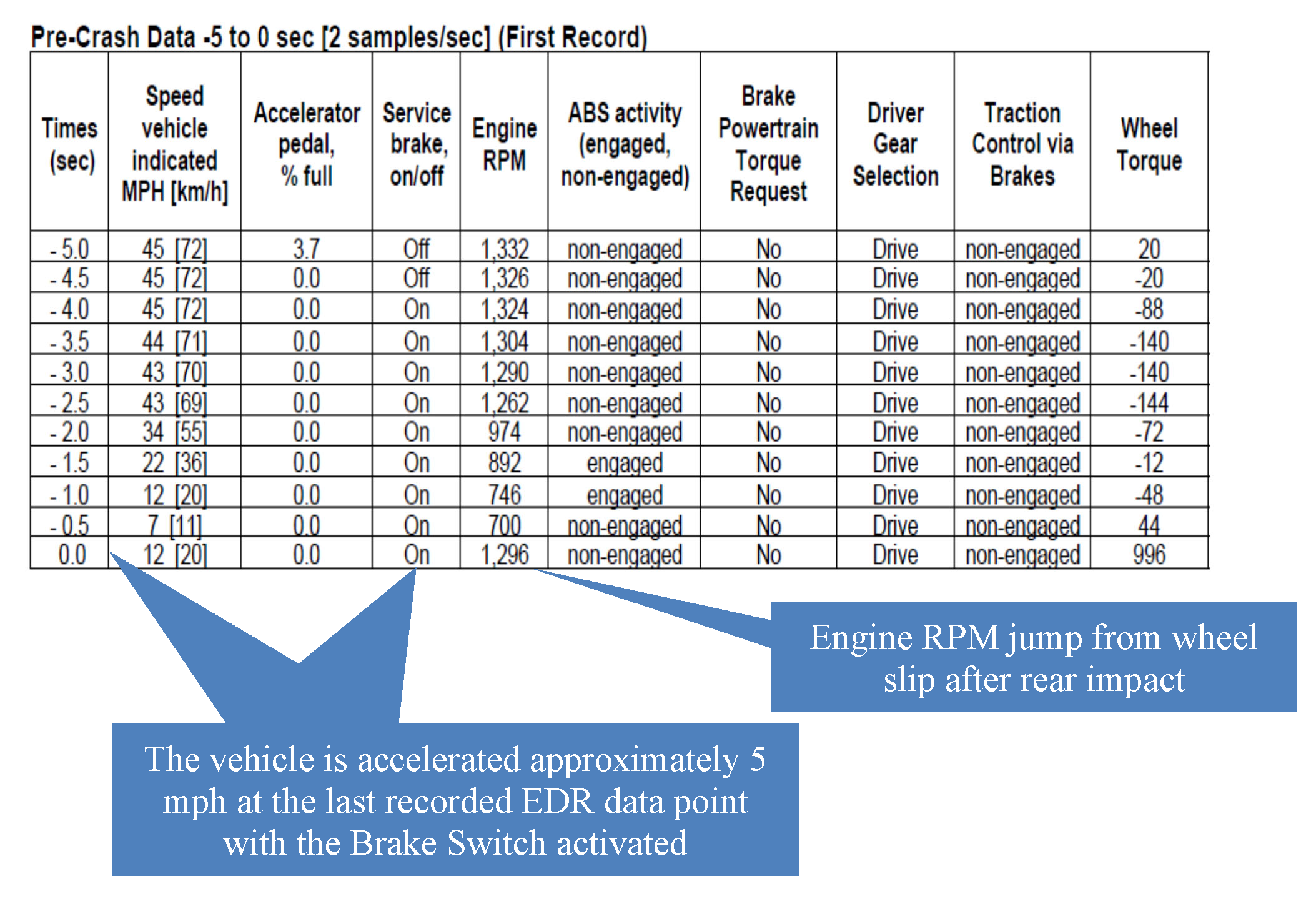
In this particular example, we see the positive Delta-V reflected in the recorded EDR vehicle speeds. This is a middle vehicle involved in a three-car collision and again shown as contributing to the collision. The vehicle’s recorded EDR shows the driver slowing from -4.0 seconds to Time Zero with the brakes engaged. At the last recorded EDR data point, the middle vehicle was accelerated, by being struck in the rear, from 7 miles per hour to 12 miles per hour, sustaining an approximate 5 mile per hour positive Delta-V prior to striking the lead vehicle.
If you have been involved in a three-car wreck as the middle car, that wreck matters to you and it matters to me. Let’s take a closer look at what really happened… don’t get the middle car blues, the wreck may not be your fault!
Mark Turner, ACTAR #2368, is a vehicle collision reconstructionist with Warren. Prior to joining Warren, he worked for 25 years as a South Carolina Highway Patrol Trooper including 10 years as a Multi-Disciplinary Accident Investigation Team (M.A.I.T.) leader (corporal). Mark is accredited as a Traffic Accident Reconstructionist by The Accreditation Commission for Traffic Accident Reconstruction (ACTAR). He investigated in excess of 900 vehicle accidents and incidents as a trooper. As a member of M.A.I.T. for 10 years, he was involved in over 1000 detailed investigations and collision reconstructions. Mark has been court qualified as an expert in accident investigation and collision reconstruction and, has testified multiple times. Mark is a member of the South Carolina Association of Reconstruction Specialists (SCARS), the International Association of Accident Reconstruction Specialists (IAARS), and the National Association of Professional Accident Reconstructionist (NAPARS).
