I love spending time at the beach. Just this last weekend I drove by four fellows on extension ladders trimming palm trees with chainsaws on the side of the street.
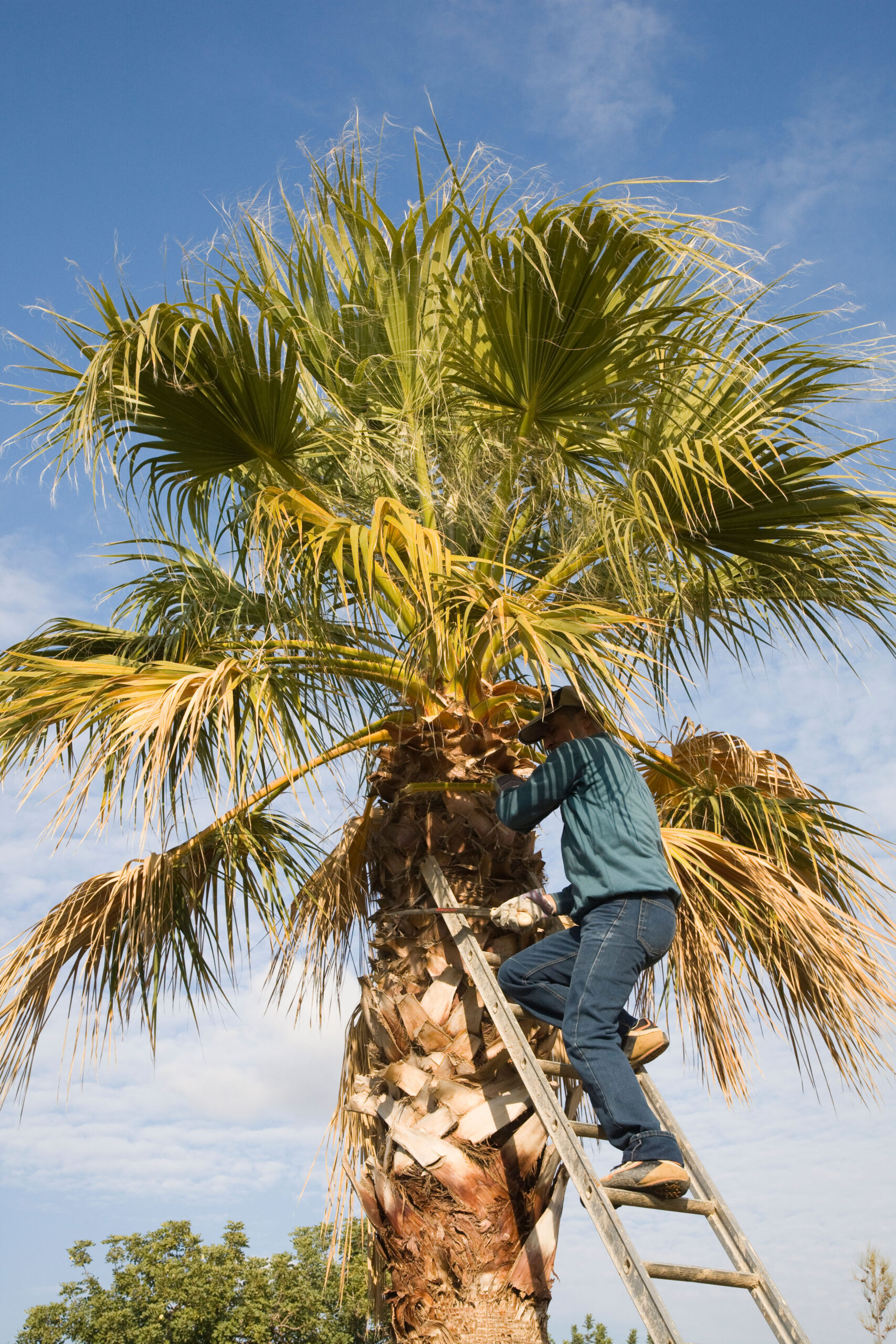
Image of a worker performing ad hoc tree work without appropriate safety considerations. Of particular concern, his ladder is at an acute angle that puts undue strain on the frame and the worker has no secondary restraints to prevent him from falling off the ladder. Ladder falls are the most common injuries in the arboricultural industry.
Of course, anyone who knows me knows that one thing I like almost as much as the beach is talking about ANSI, OSHA and liability! So, this last weekend I was concerned by the arborists’ lack of compliance with ANSI Z133: The American National Standard for Aboricultural Operations (that’s a fancy way of saying care-for/pruning/trimming/repairing and/or removing plants).
Tree pruning of smaller branches from the ground is generally an easy task with little risk to the pruner. But the American Standards Institute adopted ANSI Z133.1 (now just ANSI Z133) in 1971 to help protect against ladder falls and crushing hazards related to aboricultural operations.
According to data tracked by the Occupational Safety and Health Administration (OSHA) and the Bureau of Labor Statistics, tree trimmers and pruners face some of the highest injury and fatality rates of any industry. Falling—primarily from trees, aerial lifts, and ladders—consistently ranks as a primary cause of fatalities among tree care workers. Historical OSHA data indicates that a significant percentage of tree care injuries stem from ladder slippage, base kick-outs, and workers losing balance while performing cuts. Also, a high volume of ladder falls are directly attributed to overreaching or the unexpected shifting of a cut branch, which instantly alters the worker’s center of mass and destabilizes the ladder. ANSI Z133 provides guidance for workers to climb and operate safely.
ANSI Z133 section 8 defines tree climbing and ladder requirements. Of particular interest, section 8.1.4 says:
“8.1.4 While working aloft, the climber shall have available a climbing line and at least one other means of being secured on his/her person at all times (e.g., an arborist climbing line and a work positioning lanyard).”
Operators sometimes feel that safety equipment slows them down. This is true, but ANSI Z133 has been developed over nearly 55 years to prevent real and documented injuries. OSHA has used the General Duty Clause (Section 5(a)(1) of the OSH Act of 1970 (29 U.S.C. § 654(a)(1))) which states:
“Each employer shall furnish to each of his employees employment and a place of employment which are free from recognized hazards that are causing or are likely to cause death or serious physical harm to his employees.”
It has been used to fine arborists who fail to use multi-point safety equipment or other unsafe trimming methods. In districts with less oversight, arborists can go a long time without being cited. But that does not mean that there are exceptions to the applicability of ANSI Z133. The usage parameters of ladders are further dictated in 29 CFR 1910.23. It states that employers must ensure workers do not carry objects or position themselves in ways that compromise stability. As the traditional “3 points of contact” are impossible to maintain on a standard portable ladder while cutting limbs (you must have two hands to use a chainsaw, for example), a primary and secondary restraint as defined in ANSI Z133 are necessary. In this way, the CFR incorporates ANSI Z133.
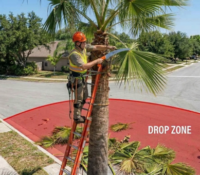
Image of a worker pruning a tree while following the intent of ANSI Z133. Note his primary and secondary harnesses keeping himself and his ladder securely in place against the tree. Also note that a spotter is required for climbers over 12 feet off the ground.
Our expert Mechanical Engineers at The Warren Group deal with ladder manufacturer defects, OSHA’s General Duty clause, and ladder design defects frequently. If you need to identify possible issues with ladder liability, we can help determine cause, as well as identifying any design defects in the products. And the next time you see someone pruning a tree, please remind them that there is an easy way and a right way.
Senior Consulting Engineer Brian Tenace, PE, FMCP®, CFEI, holds a Bachelor of Science in Mechanical Engineering and Master of Science in Mechanical Engineering from the University of Florida, a Fenestration Master through the Fenestration and Glazing Industry Alliance, and is a Licensed Professional Engineer. He has over 15 years of manufacturing and machine design experience in production and quality-driven environments. Over his engineering career, Brian worked in fenestration design in addition to designing hardware, above/below ground spill containment vessels, extrusions, dies and molds. He conducted root cause analyses for fatigue, weld, and corrosion failures in steel, springs, pressure vents and sheet metals. He developed tests according to standards and custom specifications as needed, along with modifying manufacturing processes. His failure analysis experience includes impact testing, design for ballistic protection, water infiltration resistance and corrosion. Brian has an in-depth knowledge of many standards with emphasis on fenestration standards and impact standards. Brian regularly investigates property damage claims involving machinery and equipment in a variety of environments, as well as personal injury, wrongful death, and product liability claims for both insurance adjusters and attorneys.
According to the CDC, nearly 70% of all playground injuries are caused by falls to the ground. This makes the choice and maintenance of surfacing materials one of the most important factors in preventing playground injuries. All playground surfacing material has a Critical Fall Height (CFH) that determines how much impact it can safely absorb. The Critical Fall Height is the safety threshold for playground surfacing and must always be equal to or greater than the surrounding playground equipment’s actual fall height to be considered safe. For example, Read More
Grilling outdoor during warmer months is a great way to bring people together, so long as users remember they are literally playing with fire.
Spring weather is wonderful in the south. It’s been a year since I moved and got rid of most of the things we never used in the garage. Now I’m perseverating over which grill to buy so my fiancé and I can finally make grilled turkey legs and stir-fry vegetables while watching the neighbor kids play tag between houses. Despite my pale bald head that sunburns almost instantly, I feel the need for some fresh evening air. Very little makes the afternoon better than sitting in a metal chair and joking about the neighbor’s gazebo plans while you casually take food off the grill.
I have to be honest – I sort of fear the back yard. There are gnats, neighbors with all manner of projectiles (frisbees, basketballs, volleyballs and even footballs have flown past me when all the neighborhood kids are running around!), and all the dust that my edger kicks up. But the social energy of such an active development is why I moved there. It seems a waste to eat dinner on nights like these. After all, a backyard barbecue is the highlight of summer.
But managing fire is one of the most dangerous things you can do in flip-flops. Read More
As an experienced safety consultant, I am often called upon to investigate a wide range of premises liability incidents. One common type of incident that frequently results in serious injury is a fall on a painted walking surface.
The ASTM International Standard Practice for Safe Walking Surfaces, ASTM F1637, is a nationally recognized consensus standard that has existed for more than 30 years. It provides guidance to property owners and designers in the construction and maintenance of safe walking surfaces. The standard specifically addresses painted walking surfaces in Section 5.1.3.
ASTM F1637-21 states:
5.1.3 Walkway surfaces shall be slip resistant under expected environmental conditions and use. Painted walkways shall contain an abrasive additive, cross-cut grooving, texturing, or other appropriate means to render the surface slip resistant where wet conditions may be foreseeable.
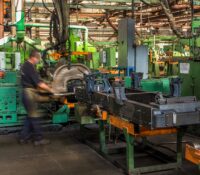
Selecting the best or most effective way to reduce or eliminate risk from a particular machine hazard is an extremely important process. It can mean the difference between someone going home and hugging their wife and children…to never going home again. The hazard control hierarchy (see figure below) is an available tool that illustrates what is known to be most effective to least effective when it comes to eliminating machine hazards or reducing the risk from those hazards to an acceptable level. Removing the hazard by designing it out is by far most effective. Read More
People have too much “stuff”. Manufacturers, retailers, wholesalers, and commercial enterprises all carry inventory of “stuff”, too. According to the Energy Information Administration’s (EIA’s) own statistics, in 2018, the US had over 17.4 billion ft2 of warehouse and storage. Growing from just 13 billion ft2 in 2012, warehouse and storage space is the fastest growing and now the largest use of commercial space in the US, overtaking office space for the first time in modern history.
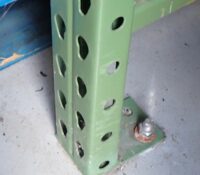
Almost every one of those buildings contains storage racks. And this doesn’t include the mercantile spaces. You can go to a big box retailer and buy cereal from a lower shelf while pallets of grain or packaged drinks sit 20-30 feet above, waiting to be introduced to the customer.
There is no specific OSHA regulation for anchoring storage racks – Read More
As we all know, change is a part of life. Sometimes the results from change are good. And we know sometimes change may result in things becoming worse, although it may not be immediately evident. I think it is safe to say that when we intentionally make changes to something, our goal is to make it better with respect to one or more metrics. Engineers working in manufacturing facilities are often asked to make changes to existing machines and processes for multiple reasons: Read More
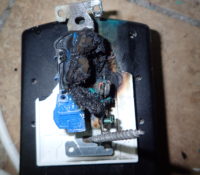
A typical residence can have upwards of 10,000 feet of electrical conductors installed, most of which are buried in the walls, attics and crawlspaces. A commercial building can have 100,000 to upwards of 1 million feet of electrical conductors. At each device such as a switch or a receptacle are at least three, and typically six or more connections of these conductors within a junction box. The connections can be in the form of twisted connectors, screw terminals, push in terminals and crimped connectors.
Welcome back to my multi-part series about water resistance in windows and doors. Last time we discussed weatherstripping. Today, we move on to a product common to sliding doors and coastal areas – sill risers.
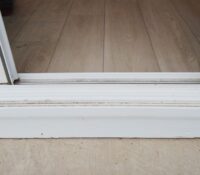
Sill risers offer a brute force way to reduce water infiltration when a LOT of water is expected to hit a fenestration product. Unlike weathersealing, buried drainage, or weep systems, sill risers block water by providing a dam. Coastal homes with wind driven rain frequently have sill risers. They are practical and require less maintenance than weep holes or buried drainage systems, plus Read More
So, you find yourself with a machine hazard that you need to guard. Where do your turn for guidance regarding guards? Several resources are available for the person who is tasked with providing machine guarding.
The United States government provides resources in the Code of Federal Regulations (CFR). These can be found at www.ecfr.gov. Title 29 of the CFR, section 1910 covers “General Industry” regulations. 1910 Subpart O, covers Machinery and Machine Guarding. Definitions are covered in 1910.211 and it is wise to understand how terms are defined. For instance, in 1910.211(a)(1), Point of operations is defined by the regulation as “that point at which cutting, shaping, boring, or forming is accomplished on the stock.” Read More