

Author Brian Tenace


It’s that time of year again. Freezing rain, flurries of snow that don’t stick around, and mornings using a spatula to scrape dreaded ice off our windshields. I’ve lived in the south most of my life, and I know the combination of excitement and dread that my compatriots and I are likely to face during the winter months. Let’s face it, we may know how to cook pulled pork, but when it comes to freezing temperatures most of us don’t have much experience!
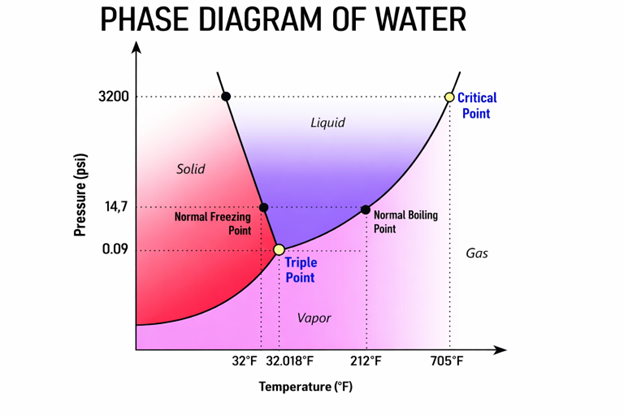
A T-P Diagram for water, showing pressures and temperatures at which water changes from liquid to gas or solid. Note the nearly vertical line between solid and liquid that indicates massive pressure requirements to keep liquid water from freezing at any particular temperature.
It takes nearly 80 times the energy to change water to ice as it does to change the same volume of water by 1˚Fahrenheit. This is because changing states of matter takes a lot of energy (in engineering we call the energy required to turn a liquid into a solid or vice-versa the enthalpy of fusion). Water, unlike most other liquids, expands approximately 9% when it turns to ice. That expansion exerts pressure on containment vessels that themselves tend to become brittle in the cold. PVC (a common conduit for water transport) becomes more brittle and shrinks as temperatures decrease. Even steel pipes can rupture if not properly protected against freezing.
A standard T-P (temperature versus pressure) diagram in undergraduate mechanical engineering thermodynamics for water and ice is fascinating! The T-P diagram shows that very high pressures can prevent water from changing to ice, but the pressures are unreasonably high for modern plumbing. Besides, the week after the ice storm when a business’s attic has flooded, academic arguments about using expensive high-pressure hoses are unwelcome.
Some engineered solutions include:
- insulation, which can greatly increase the time it takes for enclosed water to freeze
- moving enclosed water inside a temperature-controlled space
- allowing ice a path to expand (thus removing the pressure gradient involved in water’s expansion),
- removing the water from enclosed spaces.
Insulation
The insulating value (R-value) of plumbing can be used to determine how much extra time you are buying yourself. Since metal pipes especially have low insulating values (R-values), even a little insulation – especially on a reservoir of liquid – is usually effective. Doubling the effective R-value of insulation generally doubles the time it takes for water to freeze.
Of course, insulation works for short-term transient conditions. But as the last few weeks have reminded those of us on the southeastern Atlantic coast, freezing temperatures can persist for days on end a few times every decade.
This is where installers and manufacturers can be caught off guard. Product must be designed to withstand reasonably foreseeable conditions as prescribed in building codes. Transient ice is foreseeable all the way into Florida. But in a region where it can be 90˚F for six months a year, even engineers can fail to consider freezing temperatures. Long term temperatures averaging below 32˚F will eventually transition even larger bodies of stored liquids to ice. Matters can be made worse if water enclosures are elevated or exposed to high winds that carry away heat at an increased rate.
Moving Water Inside
Northern piping presents frost-resistant spigots (where the shut-off valves themselves are located inside the home), but they are relatively expensive. Slab homes do better because the water supply is buried beneath the air-conditioned space. Wet fire-suppression or other attic plumbing can be plumbed from below or installed beneath insulation. But moving water inside is generally an expensive fix that many southern homeowners cannot implement right before a freezing event.
Allowing Ice a Path to Expand
Overflow valves in larger retaining systems help for very high and very low temperatures. Expansion tanks reduce damage to piping by allowing the ice an escape route, but they don’t restrict ice formation.
Removing Water
For household and business water needs, turning off and draining water is rarely acceptable – at least in the south where freezing temperatures tend to be transient. Removing water from home or business plumbing isn’t financially feasible. Moving the water does work, since the ground temperature where the supply comes from will be well above freezing. The easiest way for fighting short-term icy conditions in external pipes is to allow the water to keep flowing (and take advantage of the huge energy – referred to in mechanical engineering textbooks as the enthalpy of fusion – requirement to convert that new water to ice).
But small tanks and jugs stored outside can burst if improperly handled. Rupture occurs, creating the extra volume for ice’s expansion. When it thaws, huge property claims can result.
Enjoy the Winter!
Feel free to contact one of our expert Mechanical Engineers at The Warren Group if you have a ruptured pipe. The signs of rupture due to freezing are unique and involve tensile failure of structures. We can help determine the load path of the failure and the time it took to freeze, as well as identifying any design defects in the product or insulation. Plus, the mechanical engineers here enjoy perusing a water T-P chart once in a while!
Senior Consulting Engineer Brian Tenace, PE, FMCP®, holds a Bachelor of Science in Mechanical Engineering and Master of Science in Mechanical Engineering from the University of Florida, a Fenestration Master through the Fenestration and Glazing Industry Alliance, and is a Licensed Professional Engineer. He has over 15 years of manufacturing and machine design experience in production and quality-driven environments. Over his engineering career, Brian worked in fenestration design in addition to designing hardware, above/below ground spill containment vessels, extrusions, dies and molds. He conducted root cause analyses for fatigue, weld, and corrosion failures in steel, springs, pressure vents and sheet metals. He developed tests according to standards and custom specifications as needed, along with modifying manufacturing processes. His failure analysis experience includes impact testing, design for ballistic protection, water infiltration resistance and corrosion. Brian has an in-depth knowledge of many standards with emphasis on fenestration standards and impact standards. Brian regularly investigates property damage claims involving machinery and equipment in a variety of environments, as well as personal injury, wrongful death, and product liability claims for both insurance adjusters and attorneys.
