As an experienced safety consultant, I am often called upon to investigate a wide range of premises liability incidents. One common type of incident that frequently results in serious injury is a fall on a painted walking surface.
The ASTM International Standard Practice for Safe Walking Surfaces, ASTM F1637, is a nationally recognized consensus standard that has existed for more than 30 years. It provides guidance to property owners and designers in the construction and maintenance of safe walking surfaces. The standard specifically addresses painted walking surfaces in Section 5.1.3.
ASTM F1637-21 states:
5.1.3 Walkway surfaces shall be slip resistant under expected environmental conditions and use. Painted walkways shall contain an abrasive additive, cross-cut grooving, texturing, or other appropriate means to render the surface slip resistant where wet conditions may be foreseeable.
Stairs that contain three or fewer risers are considered short flight stairs according to safety standard ASTM F1637-21: Standard Practice for Safe Walking Surfaces. Single step transitions are also considered a short flight stair. Short fight stairs can be particularly hazardous for pedestrians due to the lack of visual cues signifying an elevation change. Unexpected changes in elevations can cause pedestrians to misstep and fall. Read More
Trick-or-treating is a fun and festive activity, but it comes with certain hazards that can pose risks to children and even adults. In addition to vehicle and pedestrian collisions and accidents, tripping and falling while trick-or-treating is a common hazard, especially for children navigating unfamiliar and dimly lit areas at night.
Children and adults can face tripping hazards on walkways while trick-or-treating.
Tripping hazards can be mitigated through compliance with walkway safety standards such as ASTM F 1637-2021: Standard Practice for Safe Walking Surfaces. ASTM F1637 is a standard that provides Read More
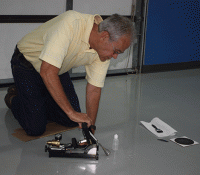
I have investigated hundreds of slip and fall incidents in my career. Today, we have new tools and technology available to assist investigators in conducting forensic investigations to determine the cause or causes of these incidents and to assist owners and operators in loss preventions efforts to minimize the potential of slip and fall incidents. Read More
As an experienced safety consultant, I’m called on to investigate a wide range of premises liability incidents. One common premises liability incident that often results in serious injury is a fall on a handicap ramp. There are at least four types of handicap ramps – flare side, parallel, returned curb and built-up. Read More
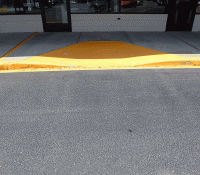
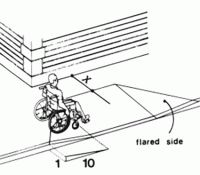
As an experienced safety consultant, I’m called to investigate a wide range of premises liability incidents. One common premises incident that often results in serious injury is a fall on a curb ramp. There are at least four types of curb ramps: flare side, parallel, returned curb and built-up. This post will focus primarily on flare side curb ramps which are the most common type constructed today. Read More
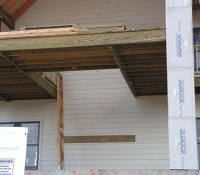
As an experienced safety consultant, I have investigated many incidents in which a worker falls through an opening. The majority of these types of fall incidents have occurred at construction sites and most resulted in a serious injury or death. Read More
As an experienced safety consultant, I’m called to investigate a wide range of premises liability incidents. One common premises incident that often results in serious injury is a trip or a fall. Read More