Forensic Engineers and Consultants

Archive: Commercial

Ready, Set, Fly! – Understanding Another Technology for Forensic Investigations

Author

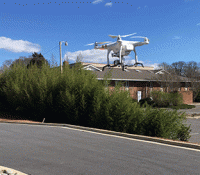
This is the first blog in a series on integrating new technologies into the process of forensic investigations.  Documenting the scene of an incident accurately, efficiently, and safely is a key step in every investigation.  Busy roadways and unstable structures present hazards to the investigator during the investigation process. The use of remote sensors can reduce these risks and provide data that otherwise could not safely be obtained. Read More
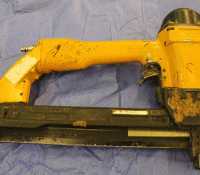
Should I Trust My Nail Gun?

Author

Can you imagine framing a house with the tools of our forefathers, using hand saws and hammers, rather than power saws and pneumatic nail guns? Power tools have made the job much easier and faster, that even the amateur is well equipped for this kind of work. Read More

Graphitic Corrosion – Difficult to determine before a failure!

Author

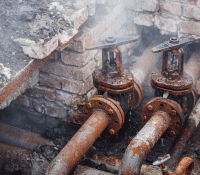
Graphitic corrosion is a process that may happen in equipment made of iron, particularly grey cast iron, but also ductile cast iron. Graphitic corrosion can lead to unexpected catastrophic failure of the affected part because the cast iron can lose its strength without a visible warning such as a change in size, shape, or appearance. Read More

The Impact of Technology on Slip and Fall Incidents

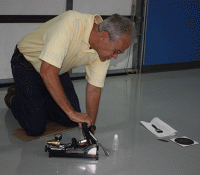
I have investigated hundreds of slip and fall incidents in my career. Today, we have new tools and technology available to assist investigators in conducting forensic investigations to determine the cause or causes of these incidents and to assist owners and operators in loss preventions efforts to minimize the potential of slip and fall incidents. Read More

Grounding versus Bonding – Understanding the Difference in Building Electrical Systems

Author

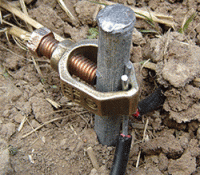
While a teenager might be very familiar with being “grounded”, there is confusion over the meaning of the word in the electrical sense. In building electrical systems, “grounding” and “bonding” are two terms that are often misunderstood. Improper application of the concepts of grounding and bonding may create lethal shock and fire hazards. “Earthing” is a term which comes from the European International Electrotechnical Committee (IEC). Earthing is synonymous with grounding but often thought to have a different meaning. Read More

Improper Design Leads to Fatigue Failure In Blower Shaft

Author

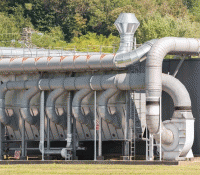
A blower used to exhaust air from an industrial process stopped functioning when the blower wheel drive shaft fractured.  The process, and thereby most of the plant, had to operate at a reduced volume until the blower wheel could be replaced.  The blower wheel had been installed during a shutdown a week before the incident.  The blower wheel was a spare installed when the existing blower wheel was sent for scheduled remanufacturing. Read More

Injury Involving a Capstan Winch

A capstan winch uses a mechanically powered rotating cylinder, called a capstan, to apply pulling force through a rope. When the rope is looped around the rotating capstan and tightened, friction between the rope and capstan allows the winch to apply force to pull a load. A typical capstan winch is shown in Figure 1 below. Read More

Timber – Falling Beam Strikes Worker

As an experienced safety consultant, I have investigated many serious injuries and deaths at construction sites over the past 39 years. The United States Department of Labor reports that the fatal injury rate for the construction industry is highest of all industries in the nation. Out of 4,386 worker fatalities in private industry in calendar year 2014, 899 or 20.5% were in construction i.e., one in five worker deaths were in construction. Read More

Defective Clevis Pin Culprit in Runaway Trailer

Author

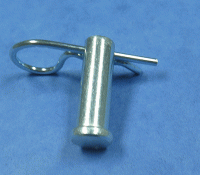
A large agricultural trailer had been connected to a truck using a clevis pin with a spring locking clip.  The trailer became disconnected from the truck and collided with an oncoming vehicle.  The trailer was in poor condition, did not have safety chains, and had substantial recent modifications by the owner. Read More

Are You Prepared for Emergencies? Your Generator Set Should Be!

Author

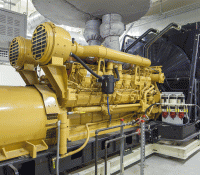
Emergency generators are often called into service during catastrophic events like hurricanes, floods, tornadoes or fires, but also during more mundane events like thunderstorms and other things that may temporarily interrupt the public power grid. Can you rely on your generator to perform at those critical times? Read More

Type ofLoss

Not sure what you're looking for?
Browse All

Select Loss Category