Forensic Engineers and Consultants

Archive: Industrial

Grounding versus Bonding – Understanding the Difference in Building Electrical Systems

Author

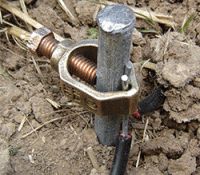
While a teenager might be very familiar with being “grounded”, there is confusion over the meaning of the word in the electrical sense. In building electrical systems, “grounding” and “bonding” are two terms that are often misunderstood. Improper application of the concepts of grounding and bonding may create lethal shock and fire hazards. “Earthing” is a term which comes from the European International Electrotechnical Committee (IEC). Earthing is synonymous with grounding but often thought to have a different meaning. Read More
Improper Design Leads to Fatigue Failure In Blower Shaft

Author

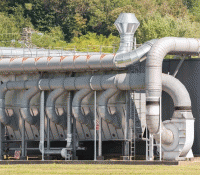
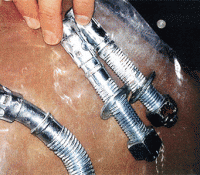
A blower used to exhaust air from an industrial process stopped functioning when the blower wheel drive shaft fractured.  The process, and thereby most of the plant, had to operate at a reduced volume until the blower wheel could be replaced.  The blower wheel had been installed during a shutdown a week before the incident.  The blower wheel was a spare installed when the existing blower wheel was sent for scheduled remanufacturing. Read More

Injury Involving a Capstan Winch

A capstan winch uses a mechanically powered rotating cylinder, called a capstan, to apply pulling force through a rope. When the rope is looped around the rotating capstan and tightened, friction between the rope and capstan allows the winch to apply force to pull a load. A typical capstan winch is shown in Figure 1 below. Read More

Timber – Falling Beam Strikes Worker

As an experienced safety consultant, I have investigated many serious injuries and deaths at construction sites over the past 39 years. The United States Department of Labor reports that the fatal injury rate for the construction industry is highest of all industries in the nation. Out of 4,386 worker fatalities in private industry in calendar year 2014, 899 or 20.5% were in construction i.e., one in five worker deaths were in construction. Read More

Are You Prepared for Emergencies? Your Generator Set Should Be!

Author

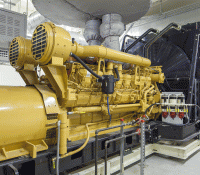
Emergency generators are often called into service during catastrophic events like hurricanes, floods, tornadoes or fires, but also during more mundane events like thunderstorms and other things that may temporarily interrupt the public power grid. Can you rely on your generator to perform at those critical times? Read More

Case Study of an Injury Involving a Soil Mixer

In May, 2014, a plant farm worker was seriously injured when he fell into the hopper of an electrically powered soil mixer.  The mixer in question used a rotating steel ribbon powered by a 7-1/2 hp electric motor to mix batches of materials such as sand, mulch, wood shavings, fertilizers and other landscaping materials to create potting soil. At the top of the hopper sidewalls, within 6 inches of the ribbon, was a steel grate. Read More

A Case Study in a Coal Mine: What are a Machine Rebuilder’s Responsibilities?

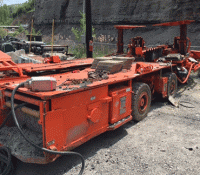
In November of 2010, a miner was injured by a roof bolting machine (roof bolter) in an Alabama underground coal mine. The roof bolter in question had undergone a complete rebuild intended to return the machine to the original equipment manufacturer’s (OEM’s) specifications. Warren was hired to analyze both the design of the roof bolter and the actions of the rebuilder to determine if either contributed to the unfortunate coal miner’s serious injury. Background information on coal mining and roof bolters, as well as an analysis of the roof bolter and the actions of the rebuilder are included. Read More

Painting of Handicap Ramps

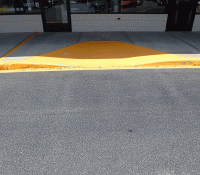
As an experienced safety consultant, I’m called on to investigate a wide range of premises liability incidents. One common premises liability incident that often results in serious injury is a fall on a handicap ramp. There are at least four types of handicap ramps – flare side, parallel, returned curb and built-up. Read More

Another Dimension of Engineering, Part 2: Visual Demonstrations Can Clarify the Issue

Author

In our last post on 3D scanning, we introduced Warren’s new Faro Focus X 330 three dimensional scanner.  To recap, the Faro scanner combines three dimensional laser measurement with automated photography to capture 360-degree data from the real world. Potential applications include vehicle accident scenes and damaged vehicles, structural collapses, fire scenes, flood damage scenes, and machinery and equipment analysis, among others. In this post, we will highlight some of the outputs that can be created from the detailed data captured by the scanner. Read More

A Steep Price: Improperly sloped curb ramps increase the potential of serious pedestrian injury

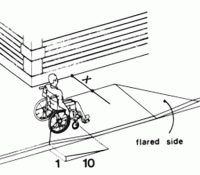
As an experienced safety consultant, I’m called to investigate a wide range of premises liability incidents. One common premises incident that often results in serious injury is a fall on a curb ramp. There are at least four types of curb ramps: flare side, parallel, returned curb and built-up. This post will focus primarily on flare side curb ramps which are the most common type constructed today. Read More

Type ofLoss

Not sure what you're looking for?
Browse All

Select Loss Category