Forensic Engineers and Consultants

Category Archive: Case Studies

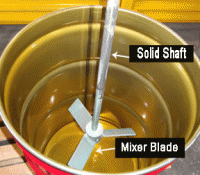
Harmless Appearing, Smooth Rotating Mixer Shaft Causes Serious Finger Amputation Injuries

I recently finished working on a case where an operator received a right hand injury when an unguarded, rotating mixer shaft caught his gloved hand between the right index finger and middle finger, twisting it around the shaft causing the index finger to separate from the hand and the middle and ring finger to be dislocated.  The mixer contained an unguarded rotating shaft, which created an uncontrolled motion hazard when rotating at speeds up to 450 RPM. Read More

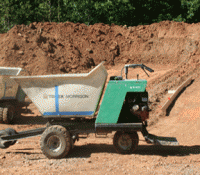
Injury on Power Buggy

Author

When an operator is thrown from a ride-on vehicle when it tips over, such as a mud buggy, serious injury or death can result. In one such case we investigated, the issue centered on the maintenance of the vehicle, specifically whether a maladjusted hydrostatic drive caused the braking mechanism to malfunction. Read More

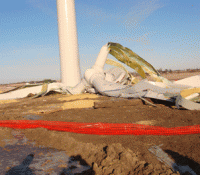
Wind Turbine Rotor Overspeed at Wind Energy Park

Author

A wind turbine was being erected as part of a small wind energy park.  The wind turbine tower and the nacelle housing the generator were successfully installed.  The three-bladed rotor assembly was installed and connected to the nacelle as the last major component of the wind turbine. Read More

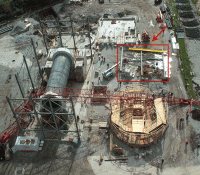
Crawler Crane Calamity at Cement Plant

Author

A production building was being constructed at a cement plant.  A large crawler crane was being used to install the pre-assembled metal wall framing of the building.  The weights and lift radii of the four wall framing sections, along with the rigging spreader and other lift equipment, were within the rated capacity of the crane. Read More

Catastrophic Weather – Lessons Learned

Author

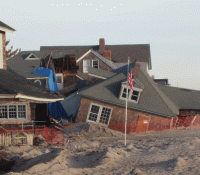
In recent years, with Hurricane Ike in Galveston, TX in 2008 and Superstorm Sandy along the New Jersey and New York coastline in 2012, we have had the opportunity to see firsthand the destructive power of storms like these.  We were “boots on the ground” literally days after the initial coastal strike.  The damage observed to residential and commercial structures was far reaching, diverse and some preventable.  We want to share some “lessons learned” from these observations for these two CAT events. Read More

Bolted Connection Failures

Author

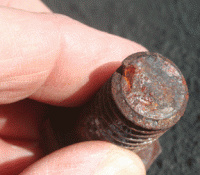
One of the most common features of machinery, consumer products, and assemblies of any type is the bolted joint. Sometimes the joint fails, with results ranging from inconsequential to catastrophic. The design of a joint is in the purview of an engineer, who must consider the material to be joined, the geometry of the joint, the loads imposed on the joint, the strength of the connectors (i.e., bolts, screws) environmental effects (i.e., temperatures, corrosion) and perhaps other factors. Read More

Forklift Falls off Loading Dock

Author

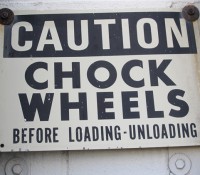
A forklift fell off the loading dock of a warehouse as it was in the process of entering a semi-trailer that was being loaded.  The forklift fell because the semi-trailer and the connected truck rolled away from the edge of the loading dock as the forklift passed over the dock leveler into the trailer.  The repeated braking forces of the forklift as it carried loads onto the trailer caused the trailer to move away from the loading dock. The semi-trailer wheels were not chocked to prevent movement away from the loading dock. Read More

Crane Pile Driving: Who Owns This Loss?

Author

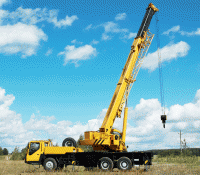
The boom of a hydraulic crane was bent while removing temporary sheet piles at a construction site.  A vibratory hammer had been placed at the top of the sheet piles to both drive and remove the piles. The vibratory pile driving placed no significant loads on the crane boom, as that operation relied on the weight of the sheet piles and the vibration of the hammer to sink the piles into the soil.  The vibration of the hammer and the lifting force of the crane boom were needed to remove the sheet piles from the soil. Read More

Uncontrolled Hazards and Risk Assessments — Part Two

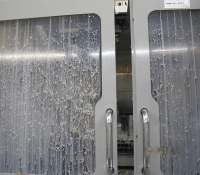
In Part One, I shared a case of a machinist blinded while using a computer numerically controlled (CNC) machining center. The equipment, which was safeguarded, contained a known hazard, but the machine manufacturer included an interlock guard to help protect the operator during the machine’s intended use. Read More

Uncontrolled Hazards and Risk Assessments — Part One

Machine equipment manufacturers are called upon to study potential risks of equipment before selling it in the marketplace. In addition, ANSI machine tool standards further address equipment hazards and risks that cannot be eliminated by design. In one case I investigated, the depth of that critical risk assessment became an important factor in a claim involving a machinist blinded while using a computer numerically controlled (CNC) machining center. Read More

Type ofLoss

Not sure what you're looking for?
Browse All

Select Loss Category