

Author Ellen Szubski

An 8-year-old girl was playing at a playground with her family. The playground was about a year old and very popular. While on the monkey bars about 7 feet up in the air, the child lost her grip and fell to the surrounding loose-fill material engineered wood fiber surface below. She hit her head and sustained serious life-altering injuries.
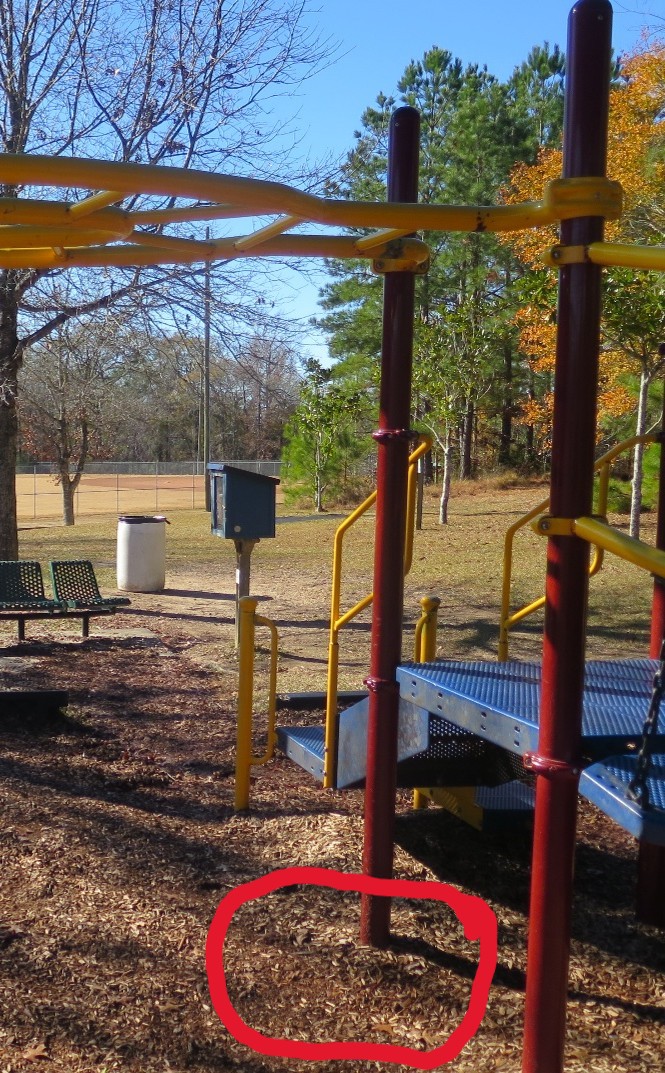
The Red circled area highlights the displaced playground surfacing in the area where the 8-year-old fell. The surfacing material only measured 3 inches deep before hitting hard compacted earth.
I was hired to investigate the incident and determine the cause of the 8-year-old’s injuries. I conducted a site inspection shortly after her fall. The surrounding area under the monkey bars where the child fell was comprised of loose-fill engineered wood fiber. Under the monkey bars was a “scuff mine” or significant depression of displaced surfacing material from frequent use and weather/water drainage. Within the depression, the depth of the engineered wood fiber measured 3 inches. Evidence suggested that when the park was built a year ago, the engineered wood fiber was 12 inches deep. There was not any maintenance program in place to inspect, rake, and replenish lost surfacing material within the playground. Thus, since its original placement, it was unlikely that the surfacing material under the monkey bars had been maintained to a safe critical fall height. Generally, loose-fill material like engineered wood fiber compresses about 25% over time. Thus, a 12 inch deep engineered wood surface would compress to 9 inches and would likely protect children falling from up to 10 feet high. At the time of the inspection, the engineered wood fiber surfacing measured 3 inches and likely only protected children from up to an estimated 3 feet in the air. The 8-year-old fell from the monkey bars located 7 feet in the air onto an insufficient depth of surfacing material. The owners knew or should have known about the dangers of improperly maintained playground surfacing. The owners of the playground failed to maintain the playground according to –STM F1487: Standard Consumer Safety Performance Specification for Playground Equipment for Public Use and CPSC Public Playground Safety Handbook.
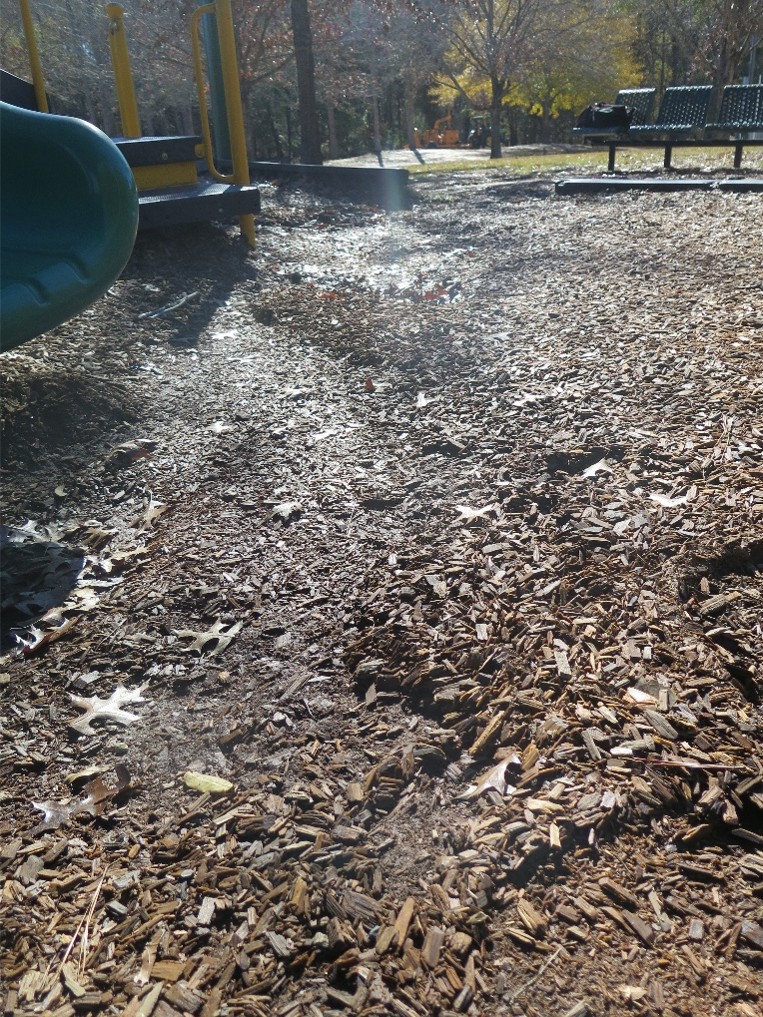
An example of displaced and washed out engineered wood fiber.
All playground surfacing material has a Critical Fall Height (CFH) that determines how much impact it can safely absorb. The Critical Fall Height is the safety threshold for playground surfacing and must always be equal to or greater than the surrounding playground equipment’s actual fall height to be considered safe. For example, if the monkey bars have a fall height of 84 inches (7 feet), the surrounding surfacing material must have a critical fall height of at least 7 feet or taller, meaning that a fall from the monkey bars onto the surrounding surface would likely not result in a serious injury. Had the incident playground been maintained to a critical fall height of at least the fall height of monkey bars (7 feet), the child would not have sustained significant injuries. The owners of the playground should have had a regular maintenance program in place to adequality maintain the critical fall height of the playground surfacing material.
Ellen Szubski, Ph.D., CXLT, CPSI, AHFP, is the senior human factors consultant at The Warren Group. She earned a Doctorate of Philosophy in Human Factors Psychology and a Master of Science in Applied Psychology from Clemson University. She did her dissertation on “The Influence of Pedestrian Biological Motion on Time-To-Collision Estimates at Night”. She is also a Certified XL Tribometrist, Certified Playground Safety Inspector and a Certified Associate Human Factors Professional (AHFP). Prior to entering the forensic field, Ellen planned and conducted experiments for a major bicycle manufacturer. She also conducted laser strike perception studies for the Department of Defense. Ellen applies her experience in Human Factors to the analysis of crash investigations and other personal injury matters. These matters often include collisions involving vulnerable road users and drivers, driver distraction, and slips, trips, and falls. She utilizes her knowledge of OSHA regulations, codes, and standards in her analysis of premises liability incidents and safety consulting. Ellen is a current member of the Human Factors and Ergonomics Society (HFES) and it’s Forensic Professional Technical Group.
