

Author Brian Tenace

I love spending time at the beach. Just this last weekend I drove by four fellows on extension ladders trimming palm trees with chainsaws on the side of the street.
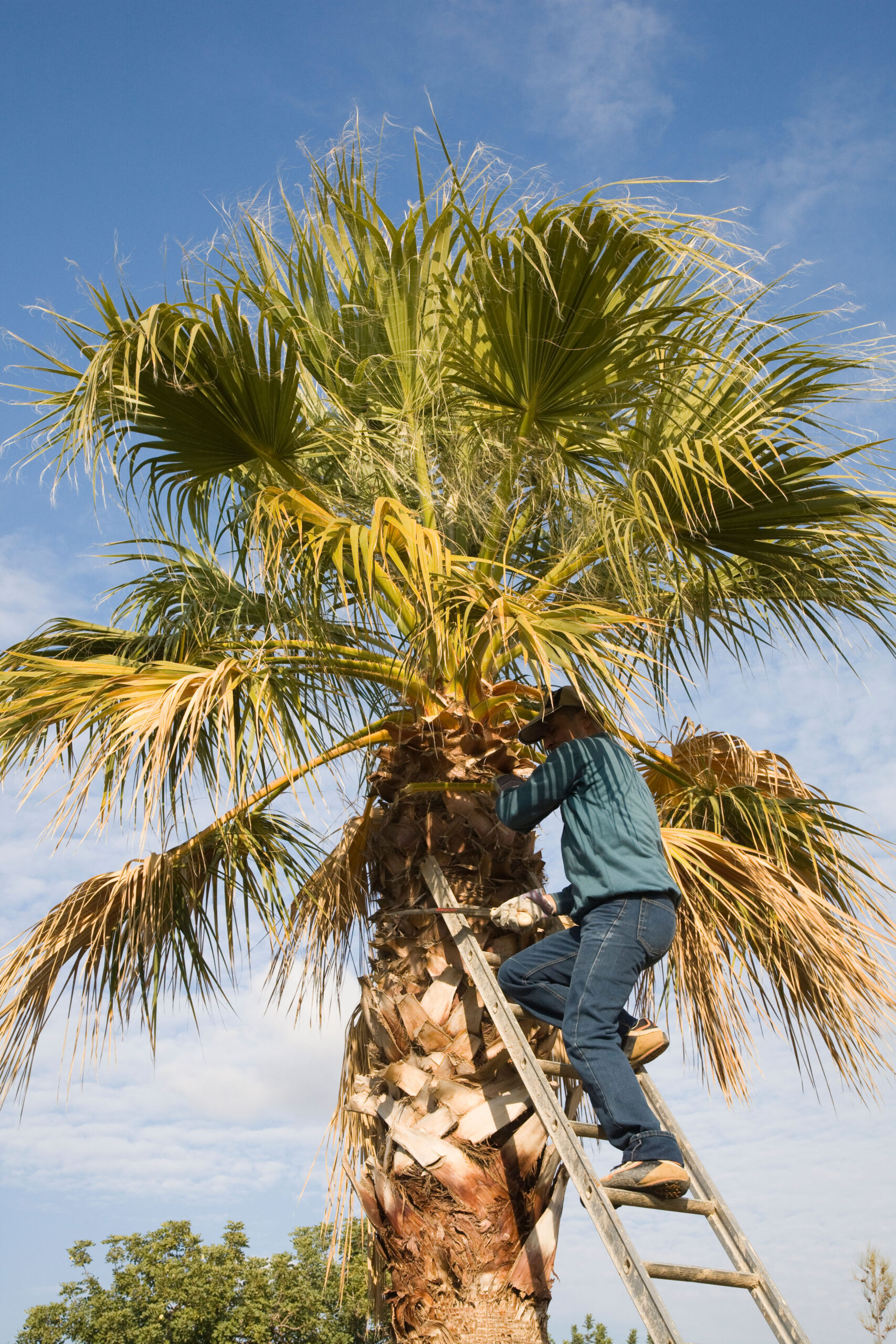
Image of a worker performing ad hoc tree work without appropriate safety considerations. Of particular concern, his ladder is at an acute angle that puts undue strain on the frame and the worker has no secondary restraints to prevent him from falling off the ladder. Ladder falls are the most common injuries in the arboricultural industry.
Of course, anyone who knows me knows that one thing I like almost as much as the beach is talking about ANSI, OSHA and liability! So, this last weekend I was concerned by the arborists’ lack of compliance with ANSI Z133: The American National Standard for Aboricultural Operations (that’s a fancy way of saying care-for/pruning/trimming/repairing and/or removing plants).
Tree pruning of smaller branches from the ground is generally an easy task with little risk to the pruner. But the American Standards Institute adopted ANSI Z133.1 (now just ANSI Z133) in 1971 to help protect against ladder falls and crushing hazards related to aboricultural operations.
According to data tracked by the Occupational Safety and Health Administration (OSHA) and the Bureau of Labor Statistics, tree trimmers and pruners face some of the highest injury and fatality rates of any industry. Falling—primarily from trees, aerial lifts, and ladders—consistently ranks as a primary cause of fatalities among tree care workers. Historical OSHA data indicates that a significant percentage of tree care injuries stem from ladder slippage, base kick-outs, and workers losing balance while performing cuts. Also, a high volume of ladder falls are directly attributed to overreaching or the unexpected shifting of a cut branch, which instantly alters the worker’s center of mass and destabilizes the ladder. ANSI Z133 provides guidance for workers to climb and operate safely.
ANSI Z133 section 8 defines tree climbing and ladder requirements. Of particular interest, section 8.1.4 says:
“8.1.4 While working aloft, the climber shall have available a climbing line and at least one other means of being secured on his/her person at all times (e.g., an arborist climbing line and a work positioning lanyard).”
Operators sometimes feel that safety equipment slows them down. This is true, but ANSI Z133 has been developed over nearly 55 years to prevent real and documented injuries. OSHA has used the General Duty Clause (Section 5(a)(1) of the OSH Act of 1970 (29 U.S.C. § 654(a)(1))) which states:
“Each employer shall furnish to each of his employees employment and a place of employment which are free from recognized hazards that are causing or are likely to cause death or serious physical harm to his employees.”
It has been used to fine arborists who fail to use multi-point safety equipment or other unsafe trimming methods. In districts with less oversight, arborists can go a long time without being cited. But that does not mean that there are exceptions to the applicability of ANSI Z133. The usage parameters of ladders are further dictated in 29 CFR 1910.23. It states that employers must ensure workers do not carry objects or position themselves in ways that compromise stability. As the traditional “3 points of contact” are impossible to maintain on a standard portable ladder while cutting limbs (you must have two hands to use a chainsaw, for example), a primary and secondary restraint as defined in ANSI Z133 are necessary. In this way, the CFR incorporates ANSI Z133.
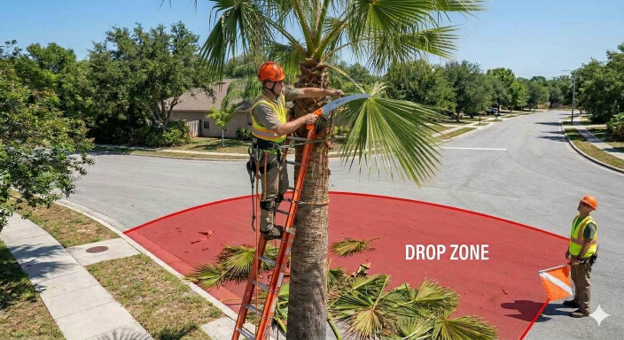
Image of a worker pruning a tree while following the intent of ANSI Z133. Note his primary and secondary harnesses keeping himself and his ladder securely in place against the tree. Also note that a spotter is required for climbers over 12 feet off the ground.
Our expert Mechanical Engineers at The Warren Group deal with ladder manufacturer defects, OSHA’s General Duty clause, and ladder design defects frequently. If you need to identify possible issues with ladder liability, we can help determine cause, as well as identifying any design defects in the products. And the next time you see someone pruning a tree, please remind them that there is an easy way and a right way.
Senior Consulting Engineer Brian Tenace, PE, FMCP®, CFEI, holds a Bachelor of Science in Mechanical Engineering and Master of Science in Mechanical Engineering from the University of Florida, a Fenestration Master through the Fenestration and Glazing Industry Alliance, and is a Licensed Professional Engineer. He has over 15 years of manufacturing and machine design experience in production and quality-driven environments. Over his engineering career, Brian worked in fenestration design in addition to designing hardware, above/below ground spill containment vessels, extrusions, dies and molds. He conducted root cause analyses for fatigue, weld, and corrosion failures in steel, springs, pressure vents and sheet metals. He developed tests according to standards and custom specifications as needed, along with modifying manufacturing processes. His failure analysis experience includes impact testing, design for ballistic protection, water infiltration resistance and corrosion. Brian has an in-depth knowledge of many standards with emphasis on fenestration standards and impact standards. Brian regularly investigates property damage claims involving machinery and equipment in a variety of environments, as well as personal injury, wrongful death, and product liability claims for both insurance adjusters and attorneys.
