

Author Claire Benedict

We’ve all done it- seen a crack in a wall or foundation and said “Eh, it’s just settlement” so we do not have to worry about it right now. But what is settlement, anyway? When does it happen, and why?
Differential or curvature settlement can cause cracks or warped materials
Unsurprisingly, “settlement” is a general term that contains several phases and types of geotechnical activity happening under a structure. The three stages of settlement that every structure will go through during and after construction are immediate settlement, consolidation settlement (also called primary settlement), and creep settlement (also called secondary settlement). The magnitude of shifting that will occur during each phase and the amount of time it will last are all heavily dependent on the soil type, how many different types of soil are present and how they are distributed, and the weight and loads applied to the structure.
Immediate settlement is the “smushing” of the soil that happens immediately after you put a heavy thing on top of it. This happens during construction and continues for the first weeks and months after a structure is completed. Soil, especially when nothing has been built on it before, has air pockets and particles that rest against one another loosely and nonuniformly. Putting a load on that soil will cause the particles to rearrange and condense as they settle into an arrangement that will support the structure over time.
Next up chronologically is consolidation settlement, also called primary settlement. Depending on the soil type underneath the structure this can take place for months or years after construction, and is caused by the water in the soil gradually being “squeezed” out by the weight of the structure. As the water leaves it creates space between soil particles, and they continue to gradually shift to remove those empty spaces.
The third and final phase of settlement is creep settlement, also called secondary settlement. This is ongoing over a period of years to possibly decades, and follows a logarithmic timeline where the movement of the soil will slow dramatically as time goes on. Because this settlement begins after most of the water has been drained in consolidation settlement, creep is result of the ongoing deformation of the soil skeleton itself rearranging under the weight of the structure.
In addition to the phases of settlement, there are different types of settlement and some are more worrisome than others. The first is uniform settlement, where settlement is uniform across the entirety of the structure and the whole structure just sinks slightly with no one the wiser. Slightly more concerning are differential and curvature settlement. As their names indicate, these are can result from different types of soil or water content in the soil across the property, variable loads within the structure, or nonuniform foundation size or depth, all of which could lead to greater settlement in some places than others.
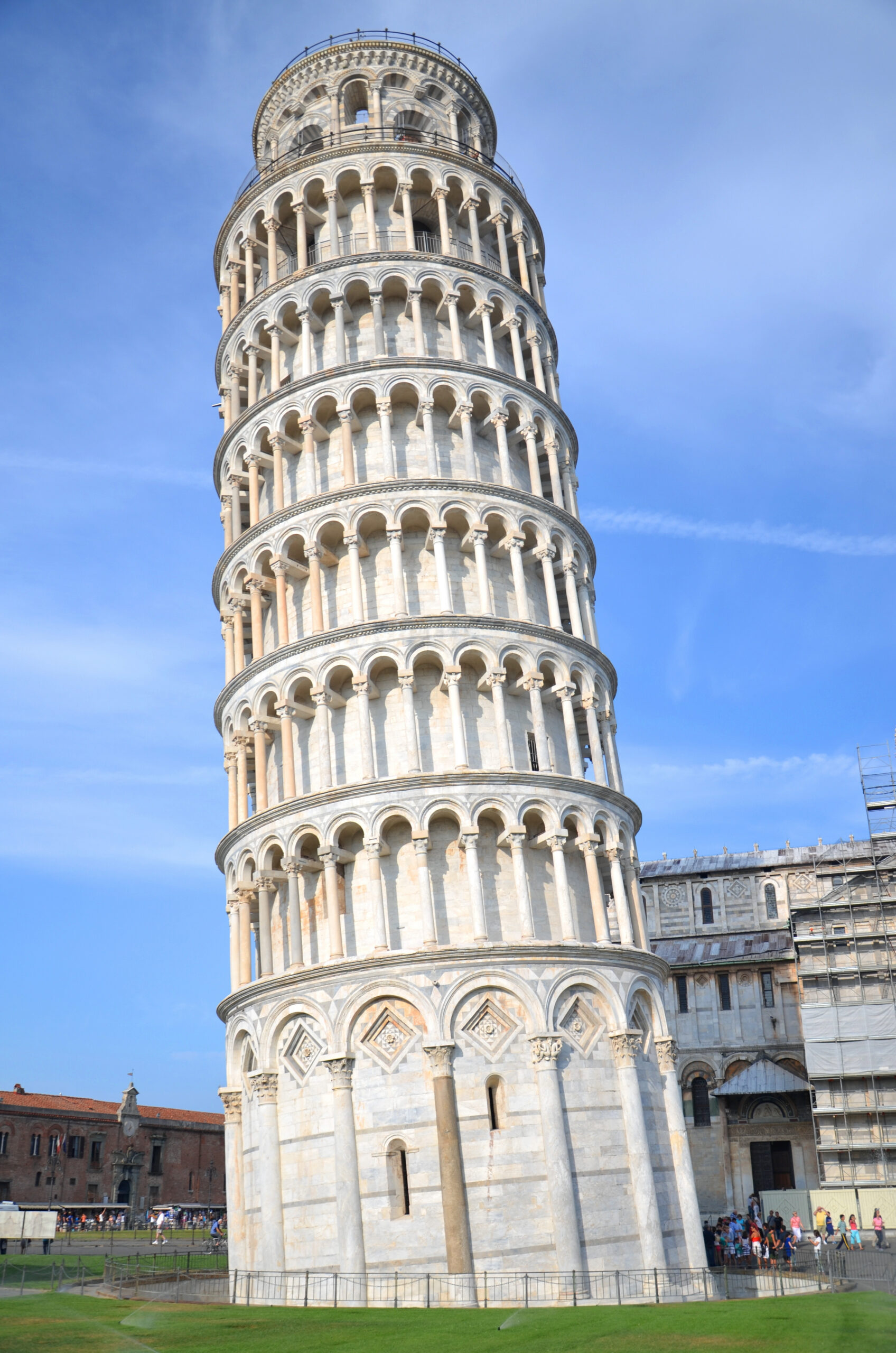
A prime example of differential settlment, the famous Leaning Tower on Square of Miracles in Pisa, Tuscany in Italy
Differential settlement can look like tipping across the entire structure (picture the leaning tower of Pisa or doors that get a little stuck on one side of the frame) or curvature settlement, where the stresses formed by the uneven settlement can cause tension or compression in pockets of the structure and result in cracks or warped materials. Hairline cracks due to settlement are expected and normal as a structure settles into its long-term shape and orientation, but any cracks that are large, continue to grow or change, or are present at a roughly 45-degree angle to the ground may be a cause for concern.
If you have noticed cracks in a structure that you feel may be cause for structural concern, the engineers at the Warren Group can help determine cause, magnitude, and scope of repair for any potential failure.
Claire Benedict, P.E., is a structural engineer licensed in South Carolina, North Carolina, Florida, and Georgia, specializing in the forensic evaluation of residential, commercial, and industrial construction. She has more than 10 years of engineering experience in the civil/structural field specializing in building design, building components, and foundation systems analysis. Claire earned her Bachelor of Science in Civil Engineering from Purdue University and is an ICC-Certified Commercial Building Inspector. Claire provides engineering analysis, site investigations, expert consultation, and litigation support involving construction defects, structural failure, moisture intrusion, and building envelope performance.
