Forensic Engineers and Consultants

Archive: Fires & Explosions

Commercial Gas-Fired Cookers Can Do More Than Burn

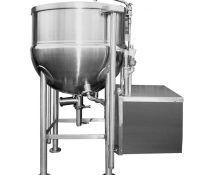
The first hazard that comes to mind when thinking about large scale ovens and steam kettles is burning or scalding injury. Carbon monoxide poisoning is just as dangerous but less understood, so oftentimes proper prevention methods are not followed. In the United States, this results in over 20,000 emergency room visits and over 400 deaths a year. Before we get to the case study and poisoning prevention methods, we need to know what CO is, where it comes from, and why it is poisonous. Read More
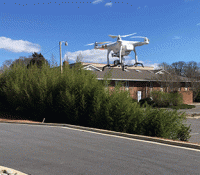
Ready, Set, Fly! – Understanding Another Technology for Forensic Investigations

Author

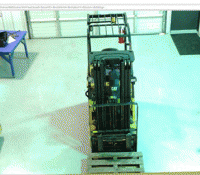
This is the first blog in a series on integrating new technologies into the process of forensic investigations.  Documenting the scene of an incident accurately, efficiently, and safely is a key step in every investigation.  Busy roadways and unstable structures present hazards to the investigator during the investigation process. The use of remote sensors can reduce these risks and provide data that otherwise could not safely be obtained. Read More

Chemical Engineers: More than Glorified Plumbers – Really!

As a senior at Virginia Tech, I was told that ChemE’s were little more than glorified plumbers.  Looking back, I’m pretty sure it was to keep our geek-egos in check. It was an effective tool! However, as I grew and traveled as a professional, it became an effective descriptor; applying to a larger scale and using a modifier or two for specific applications.  So, if you have a loss that falls into one of the categories below, a ChemE could be the expert you need. Read More

Graphitic Corrosion – Difficult to determine before a failure!

Author

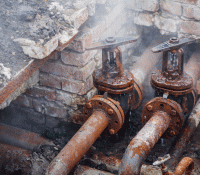
Graphitic corrosion is a process that may happen in equipment made of iron, particularly grey cast iron, but also ductile cast iron. Graphitic corrosion can lead to unexpected catastrophic failure of the affected part because the cast iron can lose its strength without a visible warning such as a change in size, shape, or appearance. Read More

New 2017 Edition of NFPA 921 Guide for Fire and Explosion Investigations

Author

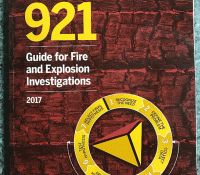
Over the course of its 25-year history, NFPA 921 Guide for Fire and Explosion Investigations has changed the practice of fire investigation for the better.  Without a doubt, NFPA 921 has appropriately driven a more rigorous approach to fire investigation that seeks to avoid cognitive bias and reliance on techniques that, when rigorously examined, are little more than pseudoscience.  One need look no further than the Cameron Todd Willingham matter, wherein a Texas man was executed in part based on a flawed fire investigation, to understand the importance of conducting a proper fire investigation. Read More

Grounding versus Bonding – Understanding the Difference in Building Electrical Systems

Author

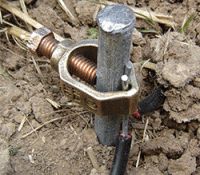
While a teenager might be very familiar with being “grounded”, there is confusion over the meaning of the word in the electrical sense. In building electrical systems, “grounding” and “bonding” are two terms that are often misunderstood. Improper application of the concepts of grounding and bonding may create lethal shock and fire hazards. “Earthing” is a term which comes from the European International Electrotechnical Committee (IEC). Earthing is synonymous with grounding but often thought to have a different meaning. Read More

Improper Fireplace Construction: Testing the Impact of Non-Compliant Clearance to Combustibles

Author

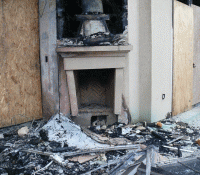
As the weather turns cold, many people use fireplaces to provide supplemental heat. The warmth from a fireplace is a comfort and the aesthetics of a glowing fire are a pleasure.  However, there is nothing pleasurable about a residential house fire that results from an improperly built or used fireplace or chimney. Read More

Another Dimension of Engineering, Part 2: Visual Demonstrations Can Clarify the Issue

Author

In our last post on 3D scanning, we introduced Warren’s new Faro Focus X 330 three dimensional scanner.  To recap, the Faro scanner combines three dimensional laser measurement with automated photography to capture 360-degree data from the real world. Potential applications include vehicle accident scenes and damaged vehicles, structural collapses, fire scenes, flood damage scenes, and machinery and equipment analysis, among others. In this post, we will highlight some of the outputs that can be created from the detailed data captured by the scanner. Read More

Warren Adds Another Dimension of Engineering

Author

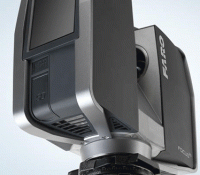
We at Warren are pleased to announce our recent purchase of a Faro Focus X 330 three dimensional scanner with FARO Scene image processing software. The scanner takes up to 976,000 data points per second and can scan objects at distances to 1000 feet.  The scanner forms a point cloud of millions of data points while also capturing 360 degree panoramic photographs.  By combining a series of scans, a three dimensional representation can be created that enables precise measurements, animations, and demonstrations. The scanner can capture imagery indoors, outdoors, and even in darkness. Read More

Analysis of Double Fatality Fire Allegedly Caused by a Portable Electric Heater

Author

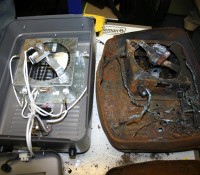
When fires occur, the effect on people’s lives is often devastating. This is especially true with fires that cause the death of a child. Clearly it is important to try and find the causes of such fires so that they can be prevented in the future. In such circumstances, it is especially important to follow a rigorous methodology in investigating the origin and cause of a fire. Investigators following a less than rigorous methodology may reach improper conclusions. Such was the case in a devastating fire investigated by Warren that was improperly alleged to have been caused by a supposedly defective product, a small electric space heater.
Read More

Type ofLoss

Not sure what you're looking for?
Browse All

Select Loss Category