Forensic Engineers and Consultants

Archive: Fires & Explosions

Firefighter Burned Due to Improper Industrial Oven Design and Operation

Author

Industrial ovens and furnaces are used in many manufacturing processes.  One use of industrial ovens is for drying and curing coatings on fabrics.

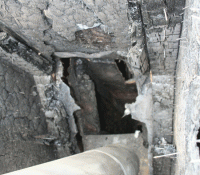
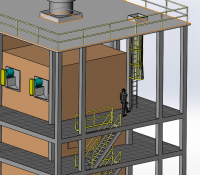
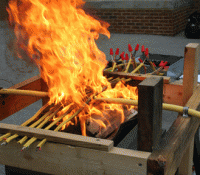
We investigated a fire loss involving a very large oven, 10 stories high, used for curing coatings on an industrial fabric. A young firefighter was burned in response to this fire, one of a string of many fires that had occurred involving the oven.
Read More

Gas Cylinder Leaks: What’s that Odor? Get out quick!

Author

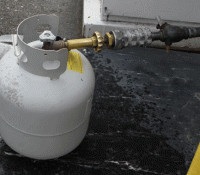
Pressurized cylinders filled with various gases are very common, from the propane fuel tank under your barbeque grill to acetylene for welding to fluorine for production of many common products.  A leak from almost any of these can cause damage or significant losses, from a fire to physical injury, or asphyxiation.

Owner protection against losses and injury can range from nothing to significant, such as storage in ventilated closets or gas detection alarms. In one case the regulator valve on a small CO2 cylinder used in a bar to pressurize beer kegs broke off. The cylinder rocketed around the bar room, causing at least one serious injury. Read More

Evaluating the Potential for “Victim” Holes Not Caused By Lightning in CSST

Author

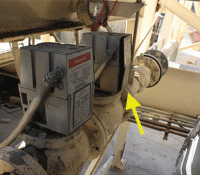
One area that we have found particularly interesting are fires involving Corrugated Stainless Steel Tubing (CSST). CSST is a material used to plumb fuel gas inside structures.  It is used as an alternative to traditional black steel pipe or copper tubing. The stainless steel tube of CSST, in certain circumstances, will perforate when subjected to electrical arcing, including that due to local lightning strikes.  The escaping fuel gas from these perforations has obvious implications as to causing fires. Read More

Forensic Examination of Losses that Include Programmable Logic Controllers (PLC’s)

Author

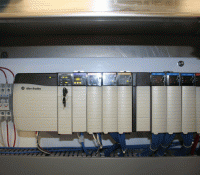
Many modern machines and processes are controlled by Programmable Logic Controllers (PLC’s).  PLC’s are essentially computers that have the ability, properly connected and programmed, to interface with the outside world and control the actions of a machine like a robot or conveyor.  The PLC has a processor for processing the user programmed logic, and also has input / output (I/O) wiring provisions for both analog (e.g. temperatures and pressure transducers) and digital (e.g. limit switches and indicator lights) devices.  Read More

Stay in Control: Manipulation of Electrical Controls Can Lead to Fires and Explosions

Author

We have a saying at Warren, “When we go to work on a new case, usually someone else has had a very bad day.” If you are a plant manager at a factory, you know it’s a bad day when you hear the fire alarm or a loud explosion emanating from the back of the plant. Read More

Container Handler Fire

Author

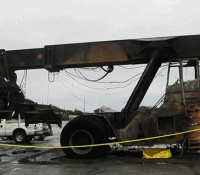
Container handlers are mobile, rubber-tired, machines that are used to load and stack standard containers at a variety of shipping terminals.  The machines resemble oversized forklifts but are equipped with shipping container lift spreaders instead of forks.  The machines are often equipped with sophisticated computer systems that inform the operator which container needs to be lifted as well as its destination, whether it is a truck, train, or storage stack. Read More

Annual Hood Suppression System Inspection

Author

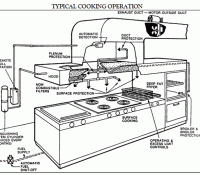
Recently, we had the opportunity to observe a semi-annual inspection of a commercial cooking fire suppression system. Before we get too far into this we would like to point out that we talked with one of the company’s owners as well as the technician about our presence there and the questions we would ask the technician. Neither of them had a problem with this request. Read More

Fire Losses Involving Improper Construction and Installation of Fireplaces and Chimneys

Author

On a cold winters night a family is gathered in the living room of their home enjoying the warmth of their fireplace.  After using the fireplace all day, they go off to bed to a nice restful sleep.  However, they are soon rudely waked by the sound of a smoke alarm in the home.  Rushing out into the cold night they can see smoke, but no flame in the home.  Outside, they can see that the chase around the fireplace chimney is burning.  The fire department is called and thankfully extinguishes the fire before it does widespread damage, however the family must leave the home for several months as repairs are made. Read More

Winter Safety Tips for Portable Electric Generators

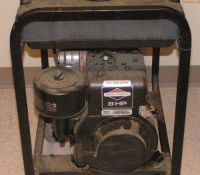
During winter ice storms, power to residences is often lost and homeowners revert to using gasoline powered portable electric generators.  It is often thought by some homeowners that leaving a generator outside in the severe weather may damage it or affect its performance and therefore resort to bringing the unit inside the shelter, typically, the garage. This is particularly hazardous when the generator is run for an extended period of time as carbon monoxide (CO) poisoning from the toxic exhaust gas can cause death. In addition, other hazards including electric shock, electrocution, fire and burns potentially can occur. Read More

[SLIDESHARE] Low Temperature Ignition of Wood

The phenomena of wood igniting when exposed for extended periods of time to temperatures below wood’s published ignition temperature value has been of considerable interest in recent years. Read More

Type ofLoss

Not sure what you're looking for?
Browse All

Select Loss Category