Forensic Engineers and Consultants

Archive: Industrial

Who Else Owns This Construction Loss Course

When a worker is badly injured on a construction site, adjusters or investigators are often hired to determine pursuit or defense of a subrogation case.  This slideshow gives an overview of several real-world investigations and helps viewers understand some of the issues involved in construction related subrogatable incidents. Read More
Container Handler Fire

Author

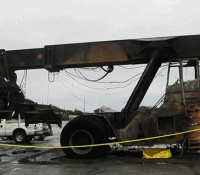
Container handlers are mobile, rubber-tired, machines that are used to load and stack standard containers at a variety of shipping terminals.  The machines resemble oversized forklifts but are equipped with shipping container lift spreaders instead of forks.  The machines are often equipped with sophisticated computer systems that inform the operator which container needs to be lifted as well as its destination, whether it is a truck, train, or storage stack. Read More

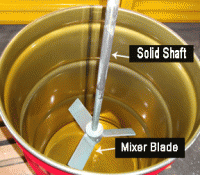
Harmless Appearing, Smooth Rotating Mixer Shaft Causes Serious Finger Amputation Injuries

I recently finished working on a case where an operator received a right hand injury when an unguarded, rotating mixer shaft caught his gloved hand between the right index finger and middle finger, twisting it around the shaft causing the index finger to separate from the hand and the middle and ring finger to be dislocated.  The mixer contained an unguarded rotating shaft, which created an uncontrolled motion hazard when rotating at speeds up to 450 RPM. Read More

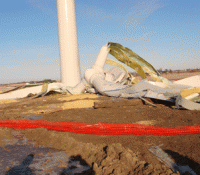
Wind Turbine Rotor Overspeed at Wind Energy Park

Author

A wind turbine was being erected as part of a small wind energy park.  The wind turbine tower and the nacelle housing the generator were successfully installed.  The three-bladed rotor assembly was installed and connected to the nacelle as the last major component of the wind turbine. Read More

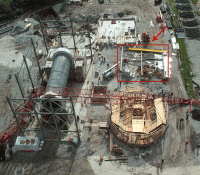
Crawler Crane Calamity at Cement Plant

Author

A production building was being constructed at a cement plant.  A large crawler crane was being used to install the pre-assembled metal wall framing of the building.  The weights and lift radii of the four wall framing sections, along with the rigging spreader and other lift equipment, were within the rated capacity of the crane. Read More

Crane Pile Driving: Who Owns This Loss?

Author

The boom of a hydraulic crane was bent while removing temporary sheet piles at a construction site.  A vibratory hammer had been placed at the top of the sheet piles to both drive and remove the piles. The vibratory pile driving placed no significant loads on the crane boom, as that operation relied on the weight of the sheet piles and the vibration of the hammer to sink the piles into the soil.  The vibration of the hammer and the lifting force of the crane boom were needed to remove the sheet piles from the soil. Read More

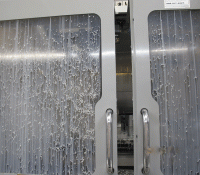
Uncontrolled Hazards and Risk Assessments — Part Two

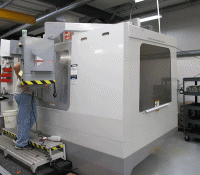
In Part One, I shared a case of a machinist blinded while using a computer numerically controlled (CNC) machining center. The equipment, which was safeguarded, contained a known hazard, but the machine manufacturer included an interlock guard to help protect the operator during the machine’s intended use. Read More

Uncontrolled Hazards and Risk Assessments — Part One

Machine equipment manufacturers are called upon to study potential risks of equipment before selling it in the marketplace. In addition, ANSI machine tool standards further address equipment hazards and risks that cannot be eliminated by design. In one case I investigated, the depth of that critical risk assessment became an important factor in a claim involving a machinist blinded while using a computer numerically controlled (CNC) machining center. Read More

Hand and Finger Injuries from a Defective Snow Blower

Author

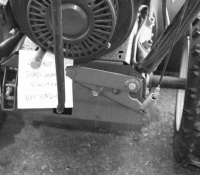
Nearly everyone who lives in a snowy climate would agree that a gas powered snow blower beats a person powered snow shovel for clearing the sidewalk or driveway.  Shoveling heavy, wet snow causes injuries from back problems to heart attacks.  No wonder that gas powered snow blowers of all sizes are a popular item this time of year.  The larger ones may be ride-on types; smaller ones are typically walk-behind.  In either case there is an auger to gather the snow as the device moves forward and a bladed fan (or “blower”) to discharge it out of a chute to one side or the other.  Read More

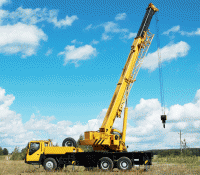
Mobile Crane Ground Support

Author

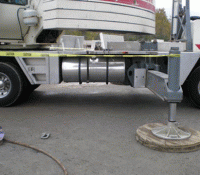
Mobile cranes depend on stability through their outriggers. These are the four “legs” that are deployed onto soil or other working surfaces adjacent to the crane.  When a mobile crane is set up at a site, the outriggers are deployed by a hydraulic mechanism that extends the four outriggers beyond the crane body and then jack the crane free of its wheels so that it is supported by the outriggers only. Read More

Type ofLoss

Not sure what you're looking for?
Browse All

Select Loss Category