Forensic Engineers and Consultants

Archive: Residential

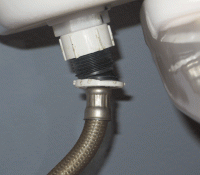
A Small Water Line Leads to a Large Loss

Author

A large oceanfront house was custom built after two years of planning and construction.  The house had three stories over an elevated foundation.  Shortly after the house was completed, the owners arrived one evening and found water pouring from above when they parked in the garage beneath the living spaces.   Read More

Who Else Owns This Construction Loss Course

When a worker is badly injured on a construction site, adjusters or investigators are often hired to determine pursuit or defense of a subrogation case.  This slideshow gives an overview of several real-world investigations and helps viewers understand some of the issues involved in construction related subrogatable incidents. Read More

Where did that hole come from? Part I

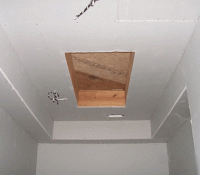
As an experienced safety consultant, I have investigated many incidents in my career in which a worker “falls through an opening.”  The majority of these incidents have occurred at construction sites and most of the ones I investigated resulted in a serious injury or death. Read More

Catastrophic Weather – Lessons Learned

Author

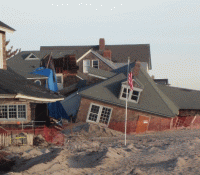
In recent years, with Hurricane Ike in Galveston, TX in 2008 and Superstorm Sandy along the New Jersey and New York coastline in 2012, we have had the opportunity to see firsthand the destructive power of storms like these.  We were “boots on the ground” literally days after the initial coastal strike.  The damage observed to residential and commercial structures was far reaching, diverse and some preventable.  We want to share some “lessons learned” from these observations for these two CAT events. Read More

How Long Before The Pipes Freeze?

Author

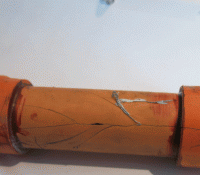
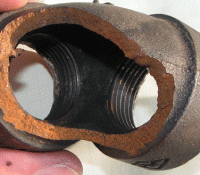
The unusually severe 2014 winter in the eastern United States has reminded many people and businesses that when water in a pipe freezes, the ice will expand and burst the pipe or pipe fitting.  Large losses will result from flooding when the temperatures rise.  Insulation will help, but not prevent freezing.  Insulation simply slows down the rate of heat loss.  The time of exposure to subfreezing temperature is an important factor. Read More

Frozen Tankless Water Heater Losses

Author

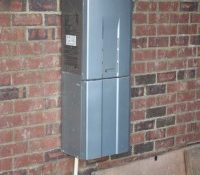
Recently, we have seen a number of water damage losses stemming from gas-fired and electric tankless water heaters exposed to freezing temperatures. Tankless hot water heaters have been growing in popularity and use due to their energy savings over traditional water heaters. These units are typically installed on the exterior of a home or business in areas of the country where prolonged freezing or extremely low temperatures are not common. Read More

Freeze Damage to Fire Sprinkler Systems

Author

The ongoing frigid temperatures serve as a reminder of the many investigations by Warren engineers involving fire sprinkler systems that have failed when some part of the system was exposed to the sub-freezing conditions. Interestingly, failures do not necessarily occur within the area of greatest freeze exposure, as the failure mechanism is the extreme pressure that results from the growth of an ice plug inside the exposed pipe in which the high pressure will rupture the weakest component which may even be located in a heated area of the sprinkler system. Read More

Fire Losses Involving Improper Construction and Installation of Fireplaces and Chimneys

Author

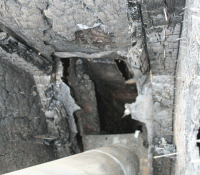
On a cold winters night a family is gathered in the living room of their home enjoying the warmth of their fireplace.  After using the fireplace all day, they go off to bed to a nice restful sleep.  However, they are soon rudely waked by the sound of a smoke alarm in the home.  Rushing out into the cold night they can see smoke, but no flame in the home.  Outside, they can see that the chase around the fireplace chimney is burning.  The fire department is called and thankfully extinguishes the fire before it does widespread damage, however the family must leave the home for several months as repairs are made. Read More

Hand and Finger Injuries from a Defective Snow Blower

Author

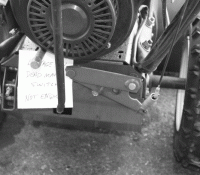
Nearly everyone who lives in a snowy climate would agree that a gas powered snow blower beats a person powered snow shovel for clearing the sidewalk or driveway.  Shoveling heavy, wet snow causes injuries from back problems to heart attacks.  No wonder that gas powered snow blowers of all sizes are a popular item this time of year.  The larger ones may be ride-on types; smaller ones are typically walk-behind.  In either case there is an auger to gather the snow as the device moves forward and a bladed fan (or “blower”) to discharge it out of a chute to one side or the other.  Read More

Winter Safety Tips for Portable Electric Generators

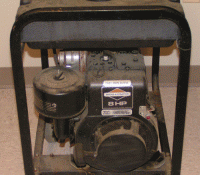
During winter ice storms, power to residences is often lost and homeowners revert to using gasoline powered portable electric generators.  It is often thought by some homeowners that leaving a generator outside in the severe weather may damage it or affect its performance and therefore resort to bringing the unit inside the shelter, typically, the garage. This is particularly hazardous when the generator is run for an extended period of time as carbon monoxide (CO) poisoning from the toxic exhaust gas can cause death. In addition, other hazards including electric shock, electrocution, fire and burns potentially can occur. Read More

Type ofLoss

Not sure what you're looking for?
Browse All

Select Loss Category